
Professional Garage Door Maintenance Service Chattanooga TN

Keep Your Door Running Smoothly Year After Year With Comprehensive Tuneโ€‘Ups, Lubrication & Safety Inspections

In Chattanoogaโ€™s variable climate โ€” hot, humid summers and chilly winter nights โ€” garage door components work harder than you might think. Metal tracks expand and contract, springs lose tension, and lubrication degrades faster than in more stable environments. Chattanooga Garage Doors Pro performs thorough maintenance designed around these real-world conditions. Every visit includes a systematic inspection of springs, cables, rollers, tracks, hinges, opener force settings, and safety sensors, so small problems donโ€™t turn into dangerous โ€” and expensive โ€” breakdowns.

What actually happens during a maintenance appointment? We start by disconnecting the opener and manually lifting the door to check its balance. A properly balanced door stays in place when opened halfway; if it drops or rises, the springs need adjustment. Next we tighten every bolt and lag screw (a leading cause of rattling doors), lubricate all rollers, hinges, and pulleys with a lithium-based grease that holds up in humidity, then test the auto-reverse mechanism and photo-eye alignment. Finally, we scan the weather stripping along the bottom and sides โ€” a damaged seal can add to your energy bills and invite pests. This isnโ€™t a quick spray-and-go service. Itโ€™s a methodical process that restores quiet, safe operation.

  • Autoโ€‘Reverse & Sensor Testing
  • Hinges, Rollers & Spring Lubrication
  • Door Balance & Spring Tuneโ€‘Up
  • Experienced Local Technicians
  • Flexible Maintenance Plans
  • Free Estimates & Sameโ€‘Day Service

Why Regular Garage Door Maintenance Is Important

A garage door is the single heaviest moving object in most homes. Even a standard 16x7 steel door weighs 150โ€“200 pounds, and over the course of a year it may travel up and down 1,500 times or more. Each of those cycles stresses springs, hinges, rollers, and the opener gearbox. Without periodic maintenance, parts donโ€™t fail overnight โ€” they wear gradually, changing the way the door moves until one day a cable snaps or a spring breaks under tension. We designed our maintenance inspections to catch those early warning signs long before they strand your car inside the garage.

During every visit we manually cycle the door to feel for resistance, measure spring drift with a spring scale, and inspect the condition of each roller bearing. We check for hairline cracks in the nylon of nylon-encased rollers (a common failure point in Chattanoogaโ€™s heat), and verify that safety sensors havenโ€™t been knocked out of alignment by a trash bin or yard equipment. If we find a roller with a flat spot or a hinge thatโ€™s starting to seize, weโ€™ll show you exactly what we see and explain your options โ€” whether thatโ€™s a simple roller replacement, a track realignment, or a cable tension adjustment. No pressure, just clear information you can act on when it makes sense for your budget and schedule.

  • Catch Wear Before Breakdowns Happen

    A noisy roller or a slight shake when the door reverses is often the only warning you get before a spring breaks. Our inspections measure actual component wear rates โ€” not just a quick spray of lubricant โ€” so you aren't caught off guard.

  • Verify Safety Systems Every Time

    We test the photo-eye response, auto-reverse force, and cable tension monitor. A door that fails to reverse on a 2x4 block of wood is a serious injury risk โ€” this test alone justifies a yearly inspection.

  • Double Spring & Opener Life Expectancy

    Springs are rated for 10,000 cycles, but a dry, unbalanced door can cut that in half. We adjust tension so the opener motor doesn't strain, extending both the spring set and the gear-and-sprocket assembly inside the motor head.

  • Eliminate Shaking, Grinding & Squeaks

    We don't mask noise with grease. We find the source โ€” loose track bolts, a bent hinge, or a bearing that's pitted โ€” and fix it. A silent door means every component is sharing the load evenly.

  • Restore True Balance & Alignment

    A balanced door stays put when released halfway. If yours slowly creeps up or down, the springs are fatigued. Correcting that prevents the opener from working against gravity and wearing out prematurely.

  • Protect Your Home's Largest Entry

    The garage door is your primary barrier against weather, pests, and intruders. A well-maintained seal and reinforced bottom bracket keep out drafts and the humidity that can warp panels and rust hardware.

Professional Garage Door Lubrication Service

Itโ€™s the numberโ€‘one DIY mistake we see: a homeowner sprays WDโ€‘40 on a squeaky track, and within weeks the noise returns louder than before โ€” because WDโ€‘40 is a solvent, not a lubricant. It strips away whatever protective film was left and leaves bare metal that rusts even faster in Chattanoogaโ€™s damp air. We use only heavyโ€‘duty lithiumโ€‘complex grease for metalโ€‘onโ€‘metal contacts (rollers, hinges, bearings) and dry silicone spray for nylon components. These products stay in place, resist washout from rain and humidity, and contain extremeโ€‘pressure additives that prevent the microscopic pitting that eventually causes rollers to seize and springs to snap. Correct lubrication isnโ€™t just about silencing squeaks โ€” itโ€™s about preserving the hardened surfaces that have to withstand thousands of stopโ€‘start cycles every year.

Our lubrication service isnโ€™t a quick sprayโ€‘over. We begin by cleaning away accumulated grit, rust powder, and driedโ€‘out grease from each roller bearing, hinge knuckle, and spring coil. Only then do we apply lubricant exactly where it belongs: into the sealed bearing of each nylonโ€‘encased roller, between the leaves of every hinge, and along the full length of torsion springs so the coils glide against each other without binding. We also flush and repack the end bearing plates and the center bearing on the torsion bar โ€” two points rarely touched by generic tuneโ€‘up services. The result is a door that actually glides, with an opener motor that draws fewer amps because friction is dramatically reduced. If youโ€™ve noticed a jerky start, a grinding noise when the door passes midโ€‘point, or a squeal that comes and goes with the weather, weโ€™ll show you exactly where dry metal is already scoring metal, and weโ€™ll fix it before youโ€™re looking at a $400 roller replacement or a snapped cable.

  • Roller Bearing Lubrication

    We inject lithium grease directly into the sealed ball bearings of each roller, not onto the track. A dry bearing quickly develops flat spots that cause a thumping sensation โ€” we catch them before they fail.

  • Spring Coil Lubrication

    Torsion springs contract and expand with every cycle. We coat each coil in a rustโ€‘inhibiting lubricant that stops corrosion and prevents the friction that leads to fatigue breaks โ€” a $25 service that protects a $300+ spring set.

  • End & Center Bearing Service

    The torsion tube spins inside bearing plates at each end and one in the center. We clean out hardened dirt and repack these bearings โ€” seized bearings increase opener load by up to 40% and are the silent killer of drive gears.

  • Hinge Pivot Lubrication

    Each hinge fold takes the doorโ€™s full weight as it rounds the track curve. Dry hinges creak, then loosen, causing panel sag. We lubricate every pivot pin and rivet, then verify the door still opens square.

Comprehensive Garage Door Safety Inspection

A garage door that opens and closes every day can still be dangerously unsafe โ€” and most homeowners wonโ€™t know it until something goes wrong. The springs that counterbalance the doorโ€™s weight hold enough stored energy to cause severe injury if they break during operation. A misaligned photoโ€‘eye sensor, even by half an inch, can prevent the door from reversing on a child, pet, or object. Thatโ€™s why our safety inspection isnโ€™t a quick visual walkโ€‘around. We physically test every safety function under real load: we place a 2ร—4 block of wood in the doorโ€™s path to verify the autoโ€‘reverse kicks in within two seconds of contact, check the force sensitivity so the door doesnโ€™t keep pressing down after meeting resistance, and clean and align the infrared sensors until the emitter and receiver are locked perfectly across the opening. Beyond the opener, we examine every loadโ€‘bearing component โ€” springs, cables, rollers, hinges, and tracks โ€” for the hidden wear that turns a routine cycle into an emergency. In Chattanoogaโ€™s humidity, surface rust on a cable can disguise internal wire fatigue; a roller bearing thatโ€™s lost its grease will soon overheat and seize. Our inspection gives you a clear, written report of whatโ€™s right, whatโ€™s wearing, and what needs attention โ€” no scare tactics, just the same honest assessment weโ€™d want on our own doors.

If we uncover a component thatโ€™s no longer safe to leave asโ€‘is, you wonโ€™t have to call another company. Our trucks are stocked for sameโ€‘day Garage Door Spring Repair, Cable Replacement, and Track Realignment. Every technician on our team has undergone hundreds of hours of training specifically around highโ€‘tension spring handling and opener force testing โ€” because garage door safety is not a part of the job you can fake.

  • Spring Inspection

    We measure coil spread to spot fatigue, check for rust bleeding from the torsion tube, and ensure safety cables are threaded through extension springs. A fatigued spring doesnโ€™t always look broken โ€” it loses tension gradually, overloading the opener.

  • Cable Inspection

    Fraying usually begins where the cable wraps around the drum, hidden from view. We run a gloved hand along the full length, feeling for a single broken strand โ€” because one broken strand means the rest will follow soon, often dropping the door without warning.

  • Roller Inspection

    We spin each roller by hand and listen for the grinding that signals a collapsed bearing. A roller with even 1mm of play can rock sideways, jump the track, and leave the door hanging โ€” a dangerous scenario weโ€™ve seen too many times.

  • Safety Sensor Testing

    We clean emitter lenses, align the beam with a bubble level, then perform both the obstruction reversal test and the forceโ€‘overload test. A sensor thatโ€™s even slightly tilted โ€” often from a bumped trash can โ€” wonโ€™t protect your kids or pets.

  • Hardware Tightening

    We torque every lag bolt, hinge screw, and track bracket to factory spec. A loose center bearing plate can let the torsion bar flex, stressing the springs and cables in unpredictable ways that lead to sudden failure.

  • Track Evaluation

    We check for plumb and level, measure the gap between track and door panel, and feel for dents or burrs that can grab a roller. Even a ยผโ€‘inch deflection at the curve forces the opener to work harder and accelerates cable drum wear.

Complete Garage Door Tune-Up Service

A true tuneโ€‘up is far more than a quick spray of lubricant โ€” itโ€™s a methodical recalibration of every subsystem that makes your garage door open and close. We start by disconnecting the opener and manually cycling the door through its full travel to feel for binding, hesitation, and balance problems that a motorized opener can mask. Then we check and correct spring tension (adding or removing quarterโ€‘turns on torsion springs until the door floats at the halfway point), tighten every nut, bolt, and lag screw on the tracks, hinges, and mounting brackets to factory torque, and adjust the vertical track alignment so the gap between the roller and the track is consistent from top to bottom. Only after the door itself moves effortlessly do we reconnect the opener and fineโ€‘tune its force sensitivity, travel limits, and safety reversal speed. The result is a door that operates so smoothly you can open it with two fingers โ€” before the opener even comes back online.

Many of the emergency repairs we handle โ€” snapped cables, stripped opener gears, broken springs โ€” trace back to a door that was out of tune for months. The opener had been working against increasing resistance until something finally gave out. A tuneโ€‘up catches that drift early. It also makes the door noticeably quieter, reduces wear on rollers and hinges, and can drop the openerโ€™s amp draw by 20โ€“30%, extending the life of its motor and circuit board. For homeowners who use their garage as a workshop, home gym, or primary entry, that difference in noise and reliability transforms daily life. This is the service that pays for itself in avoided repair bills.

  • Door Balance Testing

    We manually lift the door to its midpoint and release it. If it moves up or down, the springs are underโ€‘ or overโ€‘wound. Correcting this reduces opener load and prevents cable drum misalignment.

  • Hardware Adjustment

    We systematically tighten every lag bolt, hinge screw, track bracket, and flange nut. Loose hardware is the #1 cause of rattling, vibration, and track spreading โ€” all of which accelerate roller and hinge wear.

  • Opener Testing

    We recalibrate the upโ€‘ and downโ€‘force settings, test the autoโ€‘reverse with a 2ร—4 obstruction, and adjust travel limits so the door stops exactly at the floor and header without slamming or reversing short.

  • Performance Optimization

    After all mechanical adjustments, we cycle the door multiple times listening for any remaining squeaks or jerks, then make microโ€‘corrections until the door glides with uniform speed and no sideโ€‘toโ€‘side wobble.

Our Garage Door Maintenance Process

Every maintenance visit follows a strict, repeatable sequence โ€” nothing is skipped or rushed. We disconnect the opener first so we can feel the doorโ€™s true behavior without motor assistance, then work through a 22โ€‘point checklist that covers every loadโ€‘bearing component, safety function, and wear point. The same process has caught hundreds of failing springs, frayed cables, and misaligned sensors before they became emergencies for Chattanooga homeowners. If we find something that needs attention, we show you photos and explain exactly what weโ€™re seeing โ€” no pressure, just honest information backed by our Service Guarantee.

  • 1

    Complete System Inspection

    We manually lift the door to feel for sticking, scraping, or imbalance that an opener would mask. Then we inspect torsion springs for coil spread and rust, extension springs for stretched safety cables, cables for single broken strands near the drum, rollers for flat spots, hinges for cracking, and tracks for bends or debris. The opener rail, chain/belt tension, and all mounting brackets are checked with a flashlight โ€” nothing is left to guesswork.

  • 2

    Safety Evaluation

    Safety systems are tested under real load โ€” not just a visual glance. We clean the photoโ€‘eye lenses, align the emitter and receiver with a bubble level, and verify the door reverses immediately when the beam is broken. The autoโ€‘reverse force is tested with a 2ร—4 block of wood: the door must reverse within two seconds of contact. We also pull the emergency release cord to confirm the door opens and closes smoothly by hand and that the cord is within reach (not zipโ€‘tied to the rail).

  • 3

    Lubrication Service

    Before applying any lubricant, we clean away hardened grease, rust dust, and grit from every bearing, hinge knuckle, and spring coil. Then we inject lithiumโ€‘complex grease into sealed roller bearings, coat torsion spring coils with a rustโ€‘inhibiting spray, and lubricate all hinge pivot points and the openerโ€™s rail or chain. We never spray lubricant on tracks (it attracts dirt and causes binding) and never use WDโ€‘40, which strips protective films and invites corrosion.

  • 4

    Hardware Adjustments

    Every lag bolt, track bracket, hinge screw, and flange nut is torqued to factory specifications. Loose hardware is the most common cause of rattling, vibration, and track spreading. We realign vertical tracks so the gap between roller and track is a consistent 1/4 inch, adjust the bottom corner brackets, and verify the door panels remain flush across the opening โ€” preventing the progressive wear that leads to cable drum misalignment and broken springs.

  • 5

    Performance Testing

    After all adjustments, we reconnect the opener and run the door through five full openโ€‘close cycles. We listen for squeaks, grinding, or jerks, and watch for smooth, even travel. The door is stopped at midโ€‘point to verify it holds its position without drifting โ€” proof the springs are balanced correctly. Force and limit settings are fineโ€‘tuned so the door stops gently at the floor and header without slamming or reversing short. Only when it runs silently and consistently do we consider the job complete.

  • 6

    Maintenance Report

    You receive a detailed, written summary of every inspection point โ€” what passed, whatโ€™s showing early wear, and whatโ€™s urgent. We include photos of any problem areas (a frayed cable, a cracked roller) and prioritize recommendations so you can budget for future work on your timeline. Thereโ€™s no highโ€‘pressure sales pitch โ€” just clear documentation that helps you stay ahead of breakdowns, keep your warranty valid, and make informed decisions about your doorโ€™s care.

Garage Door Maintenance Service Throughout The Chattanooga Metro Area

Our fully stocked maintenance trucks roll out of Chattanooga every morning, covering everything from downtown lofts to hillside homes on Signal and Lookout Mountains, and across the state line into North Georgia. Whether your garage faces the humidity of Lakesite, the elevation shifts of Monteagle, or the tight clearances of a historic Red Bank bungalow, we bring the same 22โ€‘point inspection and tuneโ€‘up process to your door. We know which neighborhoods see more track shifting from seasonal ground movement, where roller rust is a recurring issue, and when extra attention to weather seals pays off in energy savings. Below are the communities we serve regularly โ€” if yours isnโ€™t listed, call anyway. Chances are weโ€™re already working down the street. For full zipโ€‘code details, visit our Service Areas page.

Why Choose Chattanooga Garage Doors Pro

A lot of maintenance companies send a salesperson with a tool bag. We send a career technician whoโ€™s spent years working on the same door models you have โ€” steelโ€‘backed Clopays, Amarr Heritage, Wayne Dalton, Chamberlain openers, whateverโ€™s on your house. The difference shows in the small things: spotting a spring coil thatโ€™s spread an eighth of an inch before it breaks, knowing exactly how many quarterโ€‘turns a Signal Mountain install needs to offset wind pressure, or recognizing that a โ€œnoisyโ€ door on a newer home in Ooltewah often traces back to factory dry rollers, not a major fault. We donโ€™t hide behind a clipboard. We walk you through what weโ€™re doing and why, so you can make informed decisions without pressure. Thatโ€™s how weโ€™ve built our reputation โ€” one maintenance visit at a time, with more than 3,000 tuneโ€‘ups completed across the Chattanooga metro.

Our team is fully insured, licensed, and factoryโ€‘trained. Every tech carries certification for highโ€‘tension spring handling and opener force limit testing. Get to know us better About Us, see exactly what we stand behind in our Service Guarantee, or reach out to schedule a visit where youโ€™ll see the difference firsthand.

  • Seasoned Maintenance Specialists

    The same technician who tunes your door today can replace a broken spring or reprogram an opener tomorrow. Weโ€™re not a rotating crew of trainees โ€” our team averages 12 years in the trade and has seen every failure mode our regionโ€™s climate can cause.

  • Safety Checks That Actually Work

    We test autoโ€‘reverse with a 2ร—4 block, not a roll of paper towels. Photoโ€‘eyes are cleaned and aligned with a bubble level. Extension springs get safetyโ€‘cable inspections. If a door fails any test, we show you right on the spot โ€” and fix it before we leave.

  • Straightforward Recommendations

    When we tell you a spring has 2,000 cycles left, we show you the coil gap we measured. If a roller is starting to flatโ€‘spot, we point to the wear line. You get a written report with photos, prioritized so you know whatโ€™s urgent and what can wait โ€” never a scare tactic.

  • Sameโ€‘Day Availability

    We maintain a local fleet stocked with springs, rollers, cables, sensors, and opener parts. Most maintenance visits include any minor repairs we find โ€” no second trip, no waiting. We also set aside emergency sameโ€‘day slots for existing customers.

  • Workmanship That Lasts

    We torque every lag bolt to manufacturer spec, not just โ€œtight enough.โ€ Track brackets are reโ€‘leveled if theyโ€™ve shifted even a quarter inch. Lubrication uses lithiumโ€‘complex grease rated for 400ยฐF, not aerosol silicone that washes out after two rains. Itโ€™s detail work โ€” because the details are what prevent breakdowns.

  • Real Service Guarantee

    If something we serviced acts up within 30 days, we come back and make it right โ€” no charge, no argument. That covers our lubrication work, adjusted springs, tightened hardware, and any replaced parts. Itโ€™s the same guarantee weโ€™d want on our own garage.

Trusted Garage Door Maintenance Services In Chattanooga TN

A garage door is a system of interdependent parts โ€” springs, cables, rollers, hinges, tracks, opener, and safety sensors โ€” and maintenance is the glue that keeps them all working together. Below youโ€™ll find a detailed breakdown of every aspect of garage door upkeep, written by the same technicians who perform these services daily throughout Hamilton County. Whether youโ€™re researching what a tuneโ€‘up actually includes, wondering why lubrication products matter, or trying to understand the safety tests your door should pass, this section gives you straight answers without sales fluff. And if youโ€™d rather leave the work to us, weโ€™re always a phone call away for garage door repair, installation, or replacement.

Garage Door Maintenance Service

A genuine garage door maintenance service doesnโ€™t begin with a spray can. It starts with the opener disconnected and the door cycled by hand, because the human arm feels resistance that a motor masks. We trace every inch of travel, checking for binding, sideโ€‘toโ€‘side wobble, and that subtle midโ€‘point grab that often signals a cracked hinge or a roller bearing thatโ€™s starting to collapse. Next, we inspect spring coils under tension with a flashlight โ€” looking for rust bleeding from the torsion tube (a sure sign of internal corrosion), measuring coil gap to estimate remaining cycle life, and verifying that safety containment cables are present on extension springs. Only after the mechanical inspection is complete do we lubricate, tighten, and reconnect the opener. This methodical sequence catches problems that quickโ€‘lube services miss, and itโ€™s the same process weโ€™ve refined across thousands of homes from East Ridge to Signal Mountain.

Maintenance frequency depends on use. A singleโ€‘car door that cycles four times a day needs at least an annual inspection. A busy family door that cycles 10โ€“12 times daily benefits from biโ€‘annual visits โ€” especially in Chattanoogaโ€™s humid summers, which accelerate rust on springs and rollers. Weโ€™ll help you set a schedule that fits your doorโ€™s actual workload, not a generic calendar. If we find a component thatโ€™s near the end of its service life, weโ€™ll show you exactly what we see and can perform sameโ€‘day spring repair or roller replacement from our fully stocked truck.
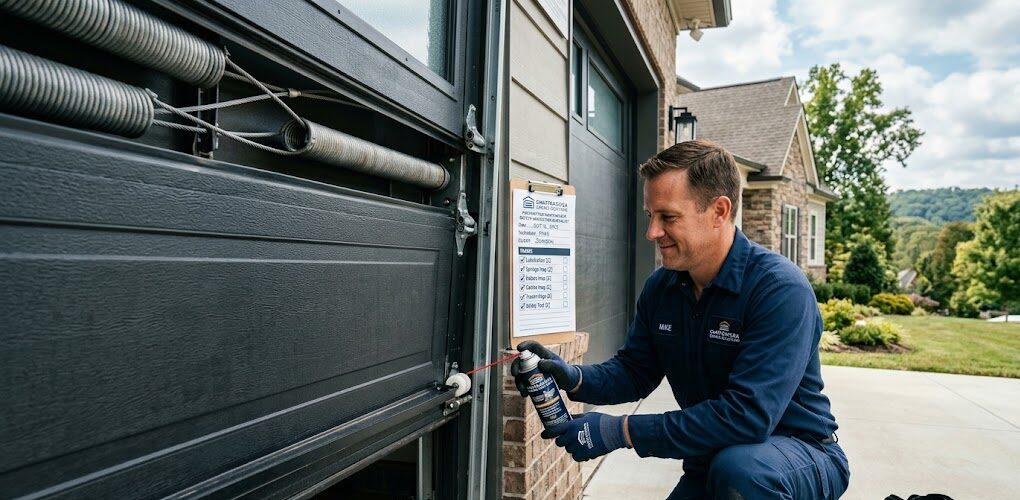
Technician performing a full maintenance inspection on a residential garage door, checking spring tension and track alignment

Garage Door Tune-Up Service

Where a maintenance visit focuses on inspection and lubrication, a tuneโ€‘up service is a handsโ€‘on recalibration of the entire system. We use a spring scale to measure the doorโ€™s weight at multiple points, then adjust torsion spring quarterโ€‘turns until the door floats perfectly at the halfway mark โ€” balanced doors reduce opener amp draw by up to 30% and dramatically extend gearโ€‘andโ€‘sprocket life. Track brackets are loosened and reโ€‘leveled if theyโ€™ve shifted even slightly, correcting the subtle misalignment that forces rollers to climb and eventually derail. Hinges are checked for sag with a straightedge, and any that have stretched are replaced on the spot.

The opener gets equal attention. We recalibrate the upโ€‘force and downโ€‘force dials so the door stops gently without slamming, adjust the travel limits to within 1/4 inch of the floor and header, and run the autoโ€‘reverse test with a 2ร—4 block to verify compliance with ULโ€ฏ325 safety standards. A door that fails this test is a serious injury risk, and we fix it before we leave โ€” often a simple forceโ€‘limit tweak or sensor cleaning, included in the tuneโ€‘up. If your opener is older and still uses a mechanical limit switch rather than electronic, weโ€™ll check for contact wear and can recommend opener installation options that add modern safety features like battery backup and smartphone control.
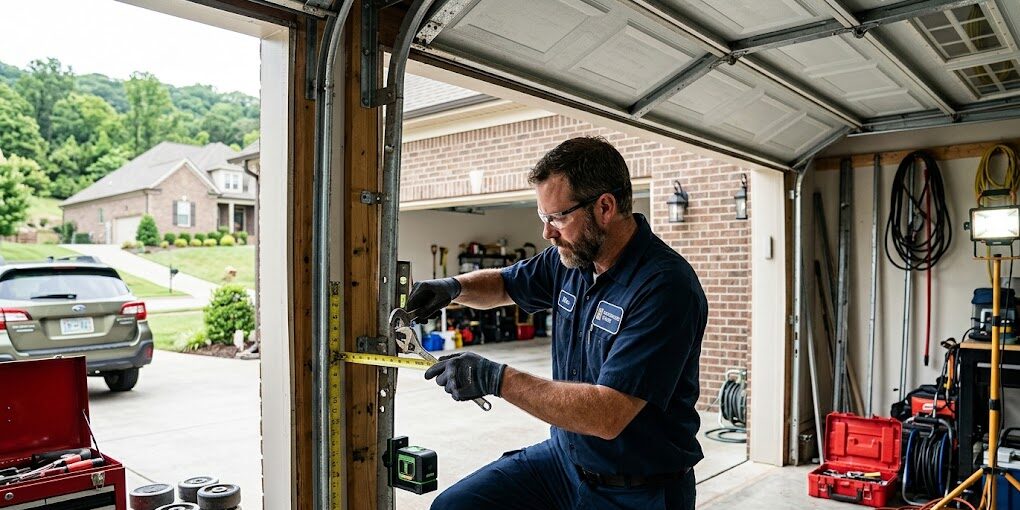
Close-up of a garage door track after realignment and tune-up, showing properly aligned rollers and freshly tightened bracket hardware

Garage Door Lubrication

Garage door lubrication is a science, not a squirtโ€‘andโ€‘go task. We use three distinct products depending on the material and location: a lithiumโ€‘complex grease for metalโ€‘onโ€‘metal contacts (roller bearings, hinge knuckles, endโ€‘bearing plates), a dry PTFE spray for nylon rollers and bushings to avoid attracting dirt, and a penetrating rust inhibitor for spring coils to stop corrosion between cycles. The wrong product โ€” like the WDโ€‘40 many homeowners reach for โ€” strips away protective films and accelerates rust. Weโ€™ve seen garage door tracks so coated with sticky spray residue that rollers literally couldnโ€™t turn, forcing the opener to drag a 180โ€‘pound door against dead friction. Thatโ€™s an extreme case, but it illustrates why product selection matters.

Lubrication is also about timing. The best moment to lubricate is after a thorough cleaning, when bearing surfaces are free of old hardened grease and metal powder. We remove the old buildup with a solvent wipe before applying fresh lubricant โ€” because packing new grease on top of contaminated grease just creates an abrasive paste. Focus areas often missed by DIY homeowners: the torsion bar center bearing, the spring anchor bracket pivot, and the opener chain or belt tensioner. A single dry bearing can increase opener load by 40%, silently cooking the drive gear until it strips. For doors with rustโ€‘prone hardware โ€” a common complaint in Lakesite and other waterfront communities โ€” we can add a corrosionโ€‘inhibiting coating during the same visit, often in combination with roller repair or track repair for a complete refresh.
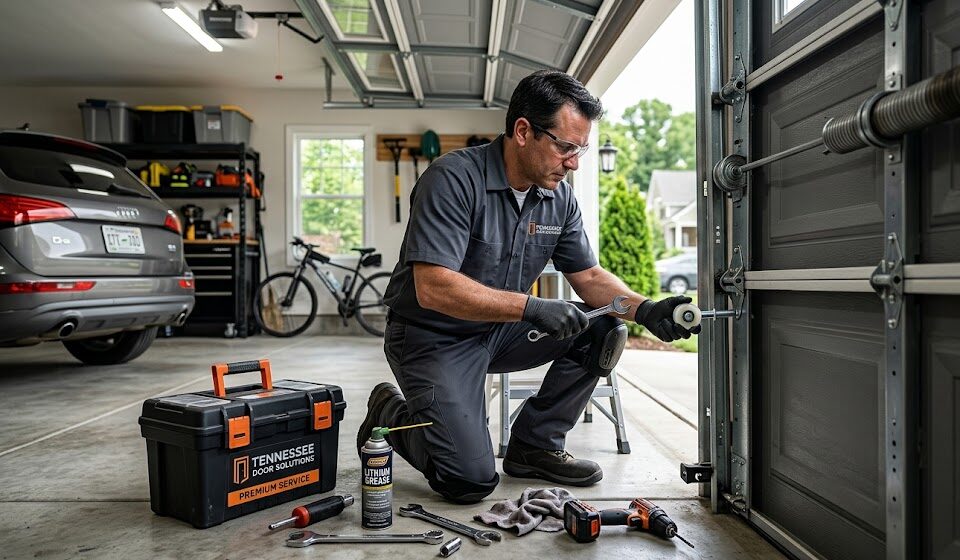
Nylon garage door roller being lubricated with a precision applicator to protect the sealed bearing while avoiding overspray onto the track

Garage Door Safety Inspection

A garage door safety inspection goes beyond sensor alignment. We test the doorโ€™s response to a 2ร—4 obstruction at three heights โ€” bottom, center, and nearโ€‘top โ€” because some openers behave differently at different points in the travel. We time the reversal: the door must stop and reverse within two seconds of contact, and the upward force must not exceed the threshold set by the manufacturer. If the door keeps pressing down after meeting resistance, the force limiter is miscalibrated or the logic board is faulty โ€” either way, itโ€™s a serious hazard that canโ€™t wait. The photoโ€‘eye beam is checked for proper modulation frequency; modern sensors use an infrared signal that must sync between emitter and receiver, and direct sunlight or a dirty lens can interrupt that signal even if the sensors โ€œlookโ€ aligned.

We also physically verify that the emergency release cord is accessible and not zipโ€‘tied to the rail โ€” a common code violation we correct on nearly every third maintenance visit. The safety inspection includes a handsโ€‘on cable check: we gently run a gloved hand along the length of each lift cable, feeling for a single broken wire strand at the drum wrap point. A frayed cable with one strand broken is a hair away from snapping under full load, and catching it early is the difference between a $45 cable replacement and a dropped door that damages panels, tracks, and whatever is underneath. Paired with cable repair and spring repair, this inspection creates a safety net that no homeowner should go without.

Technician performing a safety sensor test on a garage door, using a 2ร—4 block to verify the auto-reverse function meets safety standards

Preventive Garage Door Maintenance

Preventive garage door maintenance is about replacing parts before they fail โ€” not when they fail. Springs have a finite cycle life; a standard torsion spring is rated for 10,000 openโ€‘close cycles. For a door used eight times a day, thatโ€™s about 3.5 years before fatigue begins to degrade performance. Our preventive approach includes cycle counting and springโ€‘condition monitoring, so we can recommend replacement when springs reach roughly 80% of their rated life, not when they snap on a cold December morning and leave your car trapped. The same proactive logic applies to rollers (nylon rollers typically last 10โ€“12 years, but steel rollers in humid environments may show bearing wear in half that time), cables (replace at the first sign of fraying, not after a strand breaks), and opener drive gears (nylon gears wear predictably and can be replaced preventively for a fraction of an emergency service call).

We offer flexible preventive maintenance plans that include two visits per year, priority scheduling, and a discount on parts if replacement is needed. The plans are simple โ€” no longโ€‘term contracts, no hidden fees โ€” and each visit ends with a detailed report showing exactly what was done and what we recommend for the next six months. Preventive care is the single best way to avoid the panic of a broken spring at 7โ€ฏa.m. on a workday. Many customers pair their plan with a new door installation or replacement so everything starts fresh and stays that way. All work is backed by our service guarantee.

Technician performing preventive maintenance, inspecting garage door track alignment and tightening all bracket bolts to factory torque specifications

Residential Garage Door Maintenance

Residential garage door maintenance differs from commercial in one important way: your garage is attached to your living space, so vibration, noise, and air sealing matter just as much as mechanical reliability. A door that shakes the bedroom above it or whistles cold air through a worn bottom seal isnโ€™t just annoying โ€” itโ€™s costing you on your energy bill. Our residential focus includes checking and replacing weatherstripping (bottom seal, side jamb seals, and top header seal), tightening antiโ€‘vibration mounts on opener rails, and adding soundโ€‘dampening isolators where needed. Weโ€™ve quieted doors to the point where homeowners canโ€™t tell the door is moving from inside the house, simply by balancing the springs correctly and replacing worn steel rollers with nylon ones.

We also pay attention to the garage doorโ€™s role as a structural barrier. A properly maintained door with a reinforced bottom bracket and intact struts resists wind uplift during storms โ€” a real concern on ridges and hillsides in our service area. During maintenance visits we inspect panel connections, check for stress cracks around strut mount points, and confirm that the doorโ€™s windโ€‘load rating matches local code requirements. Whether your home is a historic Red Bank bungalow or a new build in Ooltewah, we treat the garage door as an integrated part of your homeโ€™s comfort, safety, and efficiency โ€” not just a moving wall. Our replacement doors include models with Rโ€‘value insulation that further reduce energy loss and quiet operation.

Residential garage door with insulated panels and weather seal being inspected during a maintenance visit to ensure energy efficiency and quiet operation

Garage Door Performance Testing

Garage door performance testing gives us objective data about how your door is actually functioning โ€” not just a subjective โ€œit feels smooth.โ€ We use a digital force gauge to measure the pounds of pull required to manually lift the door from closed to open; a healthy door should require no more than 8โ€“12 pounds of effort throughout its travel. If the force spikes at midโ€‘point, that indicates a track misalignment or a binding hinge. We measure speed with a stopwatch: a standard door should open fully in 15โ€“18 seconds. Slower speeds mean the opener is struggling against resistance or the springs are losing tension. We also check the doorโ€™s natural frequency response โ€” by tapping the panel at various points and listening for rattles โ€” to locate loose hardware or delaminated panel sections that are invisible to the eye.

Opener current draw is another key metric. Using a clamp meter on the motor leads, we read the amps during both open and close cycles. A spike above the nameplate rating indicates a mechanical bind thatโ€™s overloading the motor. This test has saved customers from imminent driveโ€‘gear failure more times than we can count. After any spring repair or opener repair, performance testing is the final step that confirms everything is working harmoniously โ€” and we provide the numbers to back it up, not just a thumbsโ€‘up.

Technician using a force gauge to measure the pull required to manually lift a garage door, part of a comprehensive performance test

Garage Door Hardware Inspection

A garage door hardware inspection addresses the hundreds of nuts, bolts, screws, and brackets that hold the entire system together. The most common failure we find? Lag bolts that have backed out of the track brackets, allowing the vertical track to flex inward. Each time the door passes, that flex grows, eventually spreading the track enough that a roller can jump free. We torque every lag bolt to the manufacturerโ€™s spec โ€” typically 30โ€“40 ftโ€‘lbs โ€” and replace any that show signs of stripping or rust. Hinge screws are another trouble spot: the #14 sheet metal screws that hold hinges to the door sections often loosen from vibration, and once loose they wallow out the hole, weakening the connection. We check each one and can install larger diameter screws where needed.

The bottom corner brackets, which anchor the lift cables, receive extra scrutiny. Any sign of cracking, bending, or corrosion here is a red flag โ€” these brackets bear the full weight of the door every time the opener lifts from closed. Weโ€™ve seen brackets crack at the weld and separate during a lift cycle, causing the door to twist and bind violently. A hardware inspection also covers the center bearing plate on the torsion bar, the spring anchor bracket, and the opener rail support. Pair it with track repair for a complete structural check that keeps your door safely on its rails.

Close inspection of a garage door track bracket and hardware, with a technician checking bolt torque and bracket alignment

Garage Door Safety Systems

Garage door safety systems have been mandatory since 1993, but simply having them doesnโ€™t guarantee theyโ€™ll work when needed. Photoelectric sensors must be mounted no higher than six inches off the floor, wired to the opener with clean, undisturbed connections, and kept free of dust, spider webs, and condensation. We use a multimeter to check sensor voltage and signal integrity at the opener terminals, ruling out intermittent faults that could cause a sensor to โ€œfail safeโ€ (door wonโ€™t close) or, worse, fail to reverse. For doors with optional edge sensors on the bottom seal, we test the pressureโ€‘sensitive strip across its full width, verifying that the opener immediately reverses with minimal pressure. These edge sensors are especially common on newer doors and provide an additional layer of protection beyond the photoโ€‘eyes.

The emergency release โ€” that red cord hanging from the opener rail โ€” is often overlooked until someone needs it. We verify it disengages the trolley smoothly with a single pull, and that the door can be opened and closed by hand easily once released. A door thatโ€™s too heavy to lift by hand after release indicates a spring failure or severe imbalance that the opener has been masking. We also check the doorโ€™s manual locking mechanism (if present) to ensure it doesnโ€™t accidentally engage during automatic operation. When we install a new garage door opener or perform an opener repair, we integrate all safety systems to work seamlessly โ€” and we test them in front of you so you know exactly how they should behave.

Technician cleaning and aligning a garage door photoelectric sensor lens, verifying signal integrity with a multimeter

Chattanooga Garage Door Services

Chattanooga garage door services from our team are built around understanding local conditions. The temperature swings from a Signal Mountain morning to a downtown afternoon, the humidity that settles in the valleys, and the clayโ€‘rich soil that shifts foundations and nudges track alignment โ€” these arenโ€™t hypotheticals; theyโ€™re daily realities we factor into every maintenance visit. Our fully stocked trucks carry springs, rollers, cables, sensors, and opener parts for all major brands, so most repairs happen sameโ€‘day without waiting for a second trip. We serve all of Hamilton County and the surrounding North Georgia communities, from Apison to Whitwell, and we treat every call like the house is our own.

The breadth of our services means you donโ€™t need multiple companies. In addition to maintenance, we provide repair, installation, replacement, spring repair, track repair, roller repair, cable repair, opener installation, and opener repair. Check our service areas to confirm we cover your neighborhood, and read about our service guarantee โ€” itโ€™s the same straightforward promise weโ€™d want on our own doors: do the job right, stand behind it, and treat the homeowner fairly.

Chattanooga garage door service team providing maintenance on a home in the Chattanooga area, with fully stocked service vehicle

Frequently Asked Questions

No scripts, no sales pitch โ€” just the same advice weโ€™d give a neighbor who wants their door to last 20 years without drama.

  • For most homes, once a year is the baseline โ€” but thatโ€™s a minimum. If your garage is the familyโ€™s main entrance, the door might open 10โ€“12 times a day, putting 3,500โ€“4,000 cycles on the springs annually. That kind of use demands a tuneโ€‘up every six to eight months. In Chattanoogaโ€™s sticky summers, rust sneaks into roller bearings and spring coils faster than youโ€™d think, so we often recommend a spring and fall visit. Listen to your door: a rhythmic thumping during travel usually means a roller has a flat spot; a squeal that appears only in damp weather signals surface rust that needs immediate lubrication. Commercial doors or those in dusty workshops need quarterly attention. When you call us, weโ€™ll help you nail down a schedule that fits your actual wear patterns โ€” not a calendar guess.

  • We follow a strict sequence thatโ€™s never rushed. First, we disconnect the opener and lift the door manually to feel every inch of travel โ€” sticky spots, hard stops, or uneven resistance tell us exactly where to focus. Then we go component by component: torsion springs are measured for coil gap to estimate remaining life, cables are rubbed down by hand to catch a single broken wire strand near the drum, every roller is spun and checked for bearing play, hinges are examined for hairline cracks, and the tracks are wiped clean while we verify theyโ€™re plumb and level. Hardware gets torqued to factory spec with a calibrated wrench. Only then do we lubricate โ€” lithiumโ€‘complex grease into sealed roller bearings and hinge knuckles, rust inhibitor along spring coils, never anything on the tracks. The safety system gets a live test with a 2ร—4 block; sensors are cleaned and aligned until the beam is perfect. Finally, the openerโ€™s force and travel limits are recalibrated, and we cycle the door several times, listening for anything off. You walk away with a written report showing photos of any wear we found, what we fixed, and whatโ€™s on the watch list for next time.

  • Every major repair we handle โ€” snapped spring, stripped opener gear, door off its tracks โ€” was a small, fixable issue six months earlier. A frayed cable replaced for a few dollars stops a door from dropping like a guillotine and crumpling the bottom panel. A spring whose coils are starting to separate still holds tension, but itโ€™s already past 70% of its life and will break without warning, usually at the worst moment. We use a spring scale to measure door weight and calculate how much life your springs have left, then tell you straight up. Weโ€™ve also caught cracked center bearing plates that would have shredded the torsion tube, and loose lag bolts that were slowly letting the track bow outward. Maintenance doesnโ€™t just prevent breakdowns โ€” it prevents the domino effect where one failing part takes out two or three others. Itโ€™s the difference between a controlled, planned repair you can budget for and a panicked 9 p.m. call that costs triple.

  • Different noises point to different problems, and a good maintenance visit diagnoses them by ear before a wrench ever turns. A highโ€‘pitched squeal is a dry roller bearing crying for lubricant โ€” a hit of the right grease silences it instantly. Metallic rattling usually comes from loose track bolts or a roller with worn bearings thatโ€™s bouncing in the track; tightening everything and replacing that roller ends the clatter. A grinding, scraping sound often means a cable is rubbing against a bent track bracket or the door has shifted and a hinge is dragging on the jamb. A rhythmic thumping is a flatโ€‘spotted roller slapping the track curve on every rotation. And a deep, vibrating rumble that shakes the ceiling? Thatโ€™s an unbalanced door forcing the opener to work overtime. We donโ€™t mask these with heavy grease; we fix the root cause, and the result is often so quiet you can hear the opener motor whisper.

  • Absolutely โ€” theyโ€™re the most dangerous components when they fail, so we give them the closest look. On torsion springs, we measure the gap between coils: a healthy spring has tightly packed coils, but as it fatigues the coils begin to separate, and once the gap reaches about the thickness of a nickel, the spring has maybe 20โ€“30% life left. We also check the winding cone for cracks and the set screws to make sure they havenโ€™t loosened. Extension springs get a safety cable check first โ€” that cable must run through the spring and be anchored properly so a broken spring doesnโ€™t become a projectile. For cables, weโ€™ll actually unspool the first few wraps from the drum to inspect the strands where theyโ€™re most stressed. A single broken strand is a ticking clock; weโ€™ve seen cables hold with three strands left, but they can snap any cycle after that. If we find anything questionable, weโ€™ll show you, quote a replacement, and usually have the part on the truck.

  • The math is straightforward. A spring set rated for 10,000 cycles on a door that opens eight times a day should last about 3ยฝ years โ€” but without maintenance, that same spring often fails in two because corrosion and imbalance accelerate fatigue. Replacing a spring set costs several hundred dollars; catching it during a maintenance visit when itโ€™s still functional gives you time to plan, often at a lower rate because weโ€™re already there. Over 20 years, a wellโ€‘maintained door might need one spring replacement, one set of rollers, and a few cable swaps. An ignored door might need three spring sets, a new opener gear, track repairs, and a panel replacement from a dropped door. The cost difference is thousands. Beyond money, a maintained door seals tighter, cutting drafts and energy loss in your attached garage โ€” important when that wall is shared with your living room. And the safety sensors actually work when theyโ€™re tested and cleaned twice a year. Most homeowners tell us the door feels brandโ€‘new after a tuneโ€‘up, and they kick themselves for waiting so long.

  • An opener is more than a motor; itโ€™s the brain of your door, and we treat it accordingly. During maintenance we plug in a diagnostic tool to read stored error codes on newer Chamberlain and LiftMaster units โ€” these can reveal intermittent sensor faults or overheating events youโ€™d never notice. We calibrate the force limiter using a pullโ€‘scale, not just the dial, so the door reverses with minimal resistance. Travel limits are set to stop the door exactly flush with the floor, not slamming or reversing an inch short. The autoโ€‘reverse test is done with a solid 2ร—4 at three points: bottom, middle, and nearโ€‘top. We check the chain or belt for proper tension (a loose chain eats sprockets; an overtightened belt strains the motor shaft) and inspect the nylon drive gear for wear. If your opener is preโ€‘1993 and lacks safety eyes, weโ€™ll discuss an opener upgrade to meet modern safety codes โ€” and we can do it sameโ€‘day. All adjustments, including sensor cleaning and alignment, are part of the standard maintenance price.

  • We dispatch from our Chattanooga hub every morning and reach every corner of Hamilton County and into North Georgia. That means weโ€™re regularly on Signal Mountain, Lookout Mountain, in Ooltewah, East Brainerd, Hixson, Soddyโ€‘Daisy, Red Bank, and downtown, as well as Fort Oglethorpe, Ringgold, Chickamauga, and Rossville. Our trucks are stocked to handle nearly any repair on the spot, so we donโ€™t burn your time running to a supplier. If youโ€™re in a more rural pocket like Sale Creek or Whitwell, call us โ€” we likely have a route that swings through your area already, and weโ€™ll work to fit you in without an extra trip charge. For a full zipโ€‘code map and neighborhood list, visit our FAQ page and Service Areas page, or just call. If we canโ€™t get to you, weโ€™ll be honest and recommend someone who can.

Schedule Your Garage Door Maintenance Service Today

When you call, a technician โ€” not a salesperson โ€” will walk you through exactly what to expect. Our maintenance visit takes about an hour, during which weโ€™ll disconnect the opener, feel the doorโ€™s balance by hand, inspect every spring coil and cable strand, lubricate all bearings and hinges, test your safety sensors and autoโ€‘reverse with a real obstruction, and recalibrate your openerโ€™s force and limits. Youโ€™ll receive a written report with photos showing what we found, what we fixed, and what may need attention down the road. No pressure, no upsells โ€” just honest advice from a local expert who treats your door like their own. If we spot anything urgent, weโ€™ll show you right then and give you a clear cost before we lift a tool.

  • Licensed & Insured in Tennessee
  • Sameโ€‘Day Service (We Stock Parts)
  • Free, Noโ€‘Obligation Estimates
  • Workmanship Guarantee Included