Garage Door Spring Repair Chattanooga TN

Expert Torsion & Extension Spring Repair โ€“ Fast, Safe Service for Homeowners Who Want It Done Right the First Time

Most garage door springs are engineered for about 10,000 cycles โ€“ roughly 7 to 10 years of daily use. When a spring breaks, it releases stored mechanical energy instantly, often with a loud bang, leaving the door uneven, cables slack, and the opener dangerously overloaded. On a torsion system, the spring clamps itself around the shaft; on extension springs, the break can snap safety cables if they arenโ€™t present or properly installed. We respond to these failures not just by swapping springs, but by identifying the root cause: corrosion from humidity, lack of lubrication, incorrect spring size from a previous job, or worn bearing plates that strain the assembly. Our technicians replace both springs on a two-spring system as a set (cycle life degrades in pairs), verify wire diameter, inside diameter, and length against the door weight, and wind torsion springs using calibrated bars โ€“ never impact wrenches โ€“ to preserve the temper of the metal. For extension systems, we include safety cables, inspect pulleys, and correct any bow in the horizontal track. No shortcuts, no partial fixes.

Repeated spring failures often point to issues beyond the springs themselves: unbalanced doors that side-load tracks, openers working against rust-frozen rollers, or sections that bind because of sagging struts. Thatโ€™s why a proper spring repair includes a full cycle test and balance check. If youโ€™re unsure whether the problem is limited to springs or involves deeper structural wear, our Garage Door Repair evaluation covers the complete system. Upgrading to a high-cycle spring (25,000+ cycles) might be the better investment if you plan to stay in your home long-term; we walk through these options transparently. And if the door itself is too damaged, see our Garage Door Replacement guidance. For those considering a new opener or full modernisation, our Garage Door Installation work integrates perfectly with the refreshed spring assembly.

  • Immediate Emergency Response
  • Genuine High-Cycle Springs
  • Precision Winding & Calibration
  • Full Door Safety Inspection
  • Corrosion-Resistant Coatings
  • Upfront, Honest Pricing
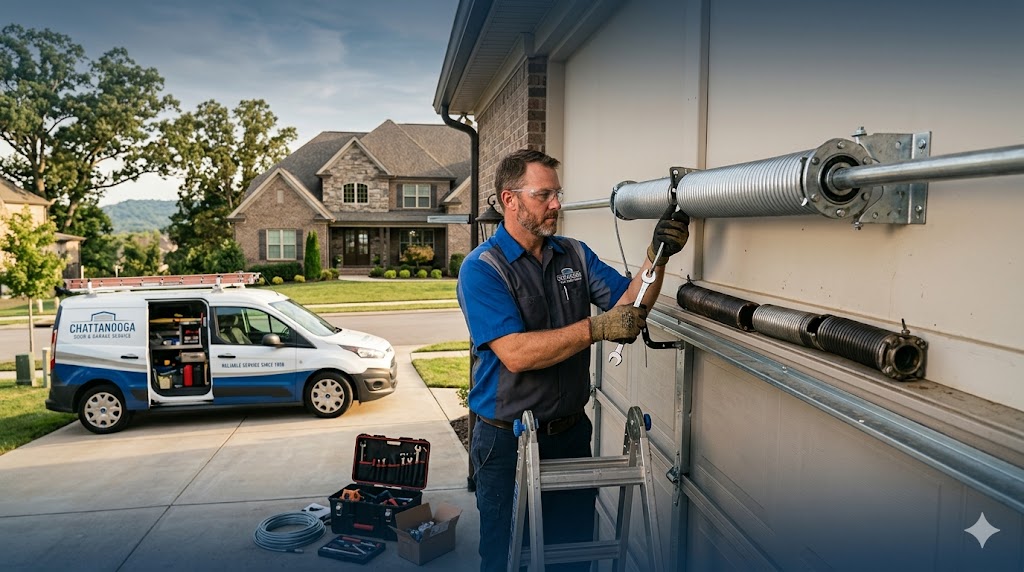
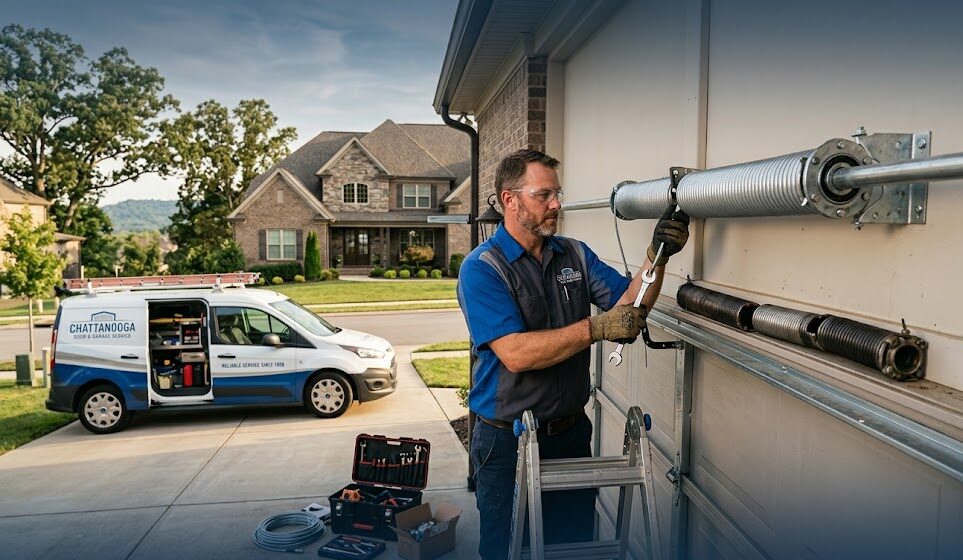
Professional garage door spring repair technician replacing torsion springs on a residential garage door in Chattanooga TN

Signs You Need Garage Door Spring Repair

Garage door springs are the muscle behind your doorโ€™s movement. A typical residential door weighs between 130 and 400 pounds, yet a properly balanced spring system makes it feel light enough to lift with one hand. That balance comes from torsion or extension springs working under immense tension. When a spring breaks, that weight shifts entirely to youโ€”or your openerโ€”creating a hazardous situation. The sudden release of stored energy often announces itself with an unmistakable sound, followed by a door that refuses to budge or lifts unevenly.

Ignoring these signs risks further damage: cables can slip, tracks can bend, and your openerโ€™s motor can burn out trying to compensate. Worse, a door under unbalanced load can come crashing down unexpectedly. If youโ€™re experiencing any of these symptoms, our Professional Garage Door Repair Services can diagnose the issue on-site. For older doors where spring failure is recurring or the door itself is damaged, we also provide Garage Door Replacement Services. We serve homeowners across Chattanooga and nearby communities with same-day response and matched spring replacements.

  • Door Won't Open

    A broken spring prevents the counterbalance system from assisting the opener. You may hear the motor run but the door stays put, or it lifts only a few inches before stalling. Disconnect the opener using the red emergency release cord and try to lift the door manually. If it feels excessively heavy or wonโ€™t budge, the springs have likely failed. Continuing to use the opener can strip its plastic gears, turning a spring replacement into a costlier repair.

  • A Loud Bang or Snap

    The sound of a torsion spring breaking under tension is unmistakableโ€”often compared to a gunshot or a car backfiring. This occurs when the metal fatigues at a microscopic level and finally snaps. If you hear this from your garage, donโ€™t operate the door or go near it. The broken pieces can be under residual force, and the door may be unstable. This is an emergency; call for professional service immediately.

  • Door Appears Crooked or Uneven

    When one spring fails, the remaining intact spring overpowers the broken side, pulling the door unevenly. Youโ€™ll see a noticeable slant, often with a gap at the bottom on one side. The door may bind in the tracks, and the rollers can chew into the track metal. Avoid forcing the door down, as this can cause cables to derail. A trained eye can spot this imbalance immediately; a level door confirms proper spring function.

  • Door Feels Heavy to Lift

    A correctly balanced door can be opened with one hand and should stay in place when lifted halfway. If you struggle to lift it or it slams down, the springs are no longer doing their job. This is dangerousโ€”an uncontrolled door can cause serious injury. Test this by pulling the emergency release cord with the door closed, then carefully lifting. If itโ€™s heavy, leave it closed and schedule a spring replacement. Never attempt to adjust the springs yourself; they hold enough tension to cause severe harm.

  • Visible Torsion Spring Break

    Look at the spring assembly above the center of the door. A torsion spring that has snapped will show a clean separation, often a 2- to 3-inch gap between the two halves. The spring typically breaks near the winding cone. Since torsion springs are rated for a certain number of cycles, a broken spring usually indicates that both springs have reached the end of their service life. For safety and balanced operation, always replace both springs at the same time. Our technicians carry a range of cycle-rated springs to match your doorโ€™s weight and usage.

  • Stretched or Rusted Extension Spring

    Extension springs are mounted along the horizontal tracks. Over time, they can stretch, develop gaps between coils, or show surface rust. A stretched spring loses its lifting power, making the door feel progressively heavier. If a spring breaks, it can become a projectile unless a safety cable is threaded through it. We inspect all extension springs and replace them in pairs with new safety cables as standard. Regular lubrication can slow wear, but once coils deform, replacement is the only safe option.

Professional Torsion Spring Replacement

Torsion springs do more than lift your doorโ€”they store the mechanical energy that counterbalances the panel stack so you can open a 150โ€‘pound door with one hand. When a spring breaks, that energy releases instantly, leaving the full weight on your opener or, worse, on you. Our replacement service starts with an accurate door weight measurement, not a guess. We calculate the correct spring rate using wire size, inside diameter, and the number of active coils, then install springs matched to your exact setup. Because most failures trace back to metal fatigue from everyday cycles, we only install cycleโ€‘rated springsโ€”standard, highโ€‘cycle, or even 50,000โ€‘cycle springs for commercial doorsโ€”so the repair lasts far longer than a quick oneโ€‘sizeโ€‘fitsโ€‘all swap.

A correctly installed and balanced spring system reduces strain on rollers, cables, and the opener motor. After a spring replacement, many homeowners find that a previously sluggish door suddenly runs smoothly and quietly again. If your door has other ageโ€‘related issuesโ€”such as rusted tracks, worn rollers, or a failing openerโ€”now is the ideal time to address them. Our Garage Door Installation Services can replace an entire system when repair is no longer costโ€‘effective, and our Garage Door Repair Services cover everything from cable replacements to opener upgrades. Every torsion spring job also includes a full system inspection, backed by our Service Guarantee.

  • Single Spring Systems

    Most singleโ€‘car doors and some lighter double doors use a single torsion spring centered above the opening. Because one spring does all the counterbalancing, precise calibration is essentialโ€”a spring thatโ€™s too strong will prevent the door from closing fully, while one thatโ€™s too weak leaves the opener straining and the door heavy to lift manually. We match replacement springs by door weight, not just length or wire gauge, and always confirm the number of active coils to set the correct torque. During installation, we also inspect the center bearing plate and end bearing plates for wear; a seized bearing can shorten a new springโ€™s life. If you have a singleโ€‘spring system, we can discuss upgrading to a twoโ€‘spring setup for smoother operation and builtโ€‘in redundancy.

  • Double Spring Systems

    Double torsion springs share the lifting load, making them the standard for heavier doubleโ€‘width doors and highโ€‘use commercial entrances. When one spring breaks, the surviving spring still carries about half the weightโ€”but itโ€™s already fatigued, having completed the same number of cycles as the broken one. For safety and balance, we always replace both springs as a matched pair, even if only one has snapped. The two new springs are identical in rated cycle life and are wound simultaneously to keep the door level. This approach prevents the uneven cable tension that leads to drum slippage and bent tracks. If your door sees many daily cycles (think busy detached garages or workshop access), we can install highโ€‘cycle springs designed for 25,000, 50,000, or even 100,000 cycles, dramatically reducing how often youโ€™ll need another replacement.

  • Spring Balancing

    Balancing isnโ€™t just winding the springโ€”itโ€™s verifying that the doorโ€™s weight is perfectly neutralized at every point of travel. We perform a handsโ€‘on balance test: after releasing the opener, we lift the door manually to waist height. A correctly balanced door stays put without drifting up or down. If it creeps upward, the spring has too much tension, forcing the opener to pull against it when closing. If it drops, thereโ€™s too little tension, and the openerโ€™s gears take the punishment. Beyond the test, we check that both sides of a dualโ€‘spring system rise evenly by measuring the gap under the door and listening for roller bind. A balanced door reduces motor stress, saves energy, and prevents the cables from jumping off the drums, a dangerous condition that can cause the door to jam crookedly.

  • Spring Safety Inspection

    Most spring failures give subtle advance warning. During a safety inspection, we look for surface rust that penetrates the wire and accelerates fatigue, small gaps between coils that indicate the spring has taken a permanent set, and wear on the winding and stationary cones where cracks can start. We measure the โ€œcreepโ€ of the set screws that hold the spring to the shaftโ€”loose screws are a common cause of sudden unwinding. The inspection also covers the lift cables, cable drums, and bottom brackets, because when a spring breaks, the sudden rotation can yank cables out of their grooves. Weโ€™ll advise you of the remaining estimated cycles on your existing springs so you can plan replacement on your schedule, not during an emergency. For commercial doors, we log cycle counts and recommend proactive changeโ€‘outs before failure disrupts operations.

Extension Spring Repair Services

Extension springs are the most common counterbalance system found on older singleโ€‘car garage doors and many newer doubleโ€‘wide doors with limited headroom. These springs mount parallel to the horizontal tracks, one on each side, and stretch as the door closes. Unlike torsion springs that store torque, extension springs store energy by expanding, and that force is what helps lift the door. When a spring failsโ€”whether from rust, metal fatigue, or simply reaching the end of its cycle lifeโ€”the entire weight shifts to the remaining spring, cables, and opener. The result is often a door that rises crooked, crashes down, or refuses to move at all. Because the break happens under tension, a snapped extension spring can also become a dangerous projectile if the mandatory safety cable is missing or improperly installed.

If your door feels unusually heavy on one side, you notice gaps between the spring coils, hear grinding from the pulleys, or have already seen a broken spring dangling from its bracket, don't keep operating the door. The added strain can strip your opener's drive gear and bend the horizontal track. Our Garage Door Repair technicians inspect every component of the extension spring assemblyโ€”springs, safety cables, pulleys, brackets, and lift cablesโ€”and fix the root cause rather than just swapping parts. If you're unsure about the condition of your springs, Contact Us to schedule a safety evaluation. We provide prompt, reliable service across all Service Areas and always carry matched pairs of cycle-rated springs to prevent future downtime.

  • Extension Spring Replacement

    We never replace just one spring. Extension springs wear out at the same rate, so a broken spring tells us its partner has completed the same number of cycles and is near failure. Our replacement starts by weighing the door to match the correct spring rateโ€”often identified by the springโ€™s color code or measured wire diameter and coil count. We remove both old springs, check the mounting brackets for deformation, and install new cycle-rated springs designed for at least 10,000 to 20,000 cycles. Every replacement includes new safety cables threaded through the spring center, secured to the bracket and track hanger. A final balance test confirms the door lifts evenly and stays in place when partially opened, reducing longโ€‘term wear on your opener and cables.

  • Safety Cable Inspection

    A safety cable is not optionalโ€”itโ€™s the difference between a contained failure and a flying spring. When an extension spring snaps, it can whip across the garage with enough force to cause serious injury or damage vehicles and stored items. The safety cable, a galvanized steel wire running through the center of the spring, captures the broken pieces and holds them in place. During our inspection, we check for fraying, kinks, proper anchoring at both ends, and free movement inside the spring. We also verify that the cable is securely fastened to a solid point on the door bracket or wall plate, not simply wrapped around a track bolt. If the cable is missing, undersized, or anchored incorrectly, we install a new 3/32โ€‘inch or 1/8โ€‘inch galvanized cable before any other spring work proceeds.

  • Pulley Inspection & Replacement

    The pulleys at the rear of the horizontal tracks do more than just redirect the lift cableโ€”they directly affect spring efficiency and door smoothness. A worn pulley bearing creates a highโ€‘pitched squeal, jerky door movement, and increased friction that makes the springs work harder. Our inspection measures sideโ€‘toโ€‘side play in the sheave, checks for cracked or rusted pulley wheels, and evaluates the condition of the clevis pin and cotter pin that hold the pulley to the bracket. We replace marginal pulleys with sealedโ€‘bearing units that never need lubrication and handle the constant tension of the spring system without seizing. If a pulley has already seized, the cable may have started to fray; weโ€™ll inspect the entire cable length and replace it if necessary to prevent a sudden drop while the door is in motion.

  • Spring Tension Adjustment

    Over years of use, extension springs can take a permanent setโ€”they stretch slightly and lose their original lifting power. This causes a door that drifts downward when fully open, or refuses to stay open halfway. Tension adjustment isnโ€™t simply tightening a bolt; it involves carefully shortening the cable or adjusting the Sโ€‘hook connection to increase the springโ€™s preโ€‘stretch. We perform this with the door fully open, where spring tension is lowest, and adjust both sides equally so the door remains perfectly level. After adjustment, we cycle the door multiple times and test the balance at multiple positions: the door should feel nearly weightless at waist height and should not selfโ€‘open or selfโ€‘close. A properly tensioned system dramatically reduces opener stress and prevents cables from jumping off the drum plates, a common cause of sudden door jams.

Our Garage Door Spring Repair Process

Replacing a broken spring is not a parts-swapโ€”itโ€™s a precision counterbalance job. We follow a systematic five-step process that starts with identifying the root cause of the failure and ends with a door that lifts with one hand and stays exactly where you leave it. Every step is built around the doorโ€™s actual weight, not a guess, and no repair leaves our hands without a full-cycle balance and safety confirmation. Hereโ€™s exactly how we keep your door running smoothly and, most importantly, safely.

  • 01

    Spring Inspection

    We start by weighing the door with a digital scale to know exactly what the springs are up against. Then we examine every spring coil under a bright light for surface rust that can mask fatigue cracks, measure the gap between coilsโ€”a stretched spring has lost its lifting power even before it snapsโ€”and check the winding and stationary cones for hairline fractures. Set screws that have backed off even a fraction of a turn signal that the spring has been slipping on the shaft, slowly degrading the torsion. We also trace the lift cables from the drums to the bottom brackets; a fray here often means the broken spring jerked the drum suddenly. This inspection often uncovers secondary issues, like seized bearings or a worn center bushing, that would shorten the life of a new spring.

  • 02

    Damage Diagnosis

    A broken spring isnโ€™t just a failed piece of metal; itโ€™s often a symptom. We trace the root cause so the new springs donโ€™t suffer the same fate. If a spring snapped after only a few years, we check for door imbalance that could have overloaded one side, an opener that was forcing the door against ice or a stuck roller, or missing safety cables that allowed a broken extension spring to whip. We look at the entire load path: bent rollers chew up tracks and create resistance, a misaligned vertical track transfers lateral force to the spring shaft, and an underpowered opener that struggles daily can overheat the motorโ€”something that happens when a door is too heavy because a spring was never properly tensioned. We diagnose the contributing factors, not just the broken part, and explain what weโ€™ll do to correct them so the repair holds up for the rated cycle count.

  • 03

    Spring Selection

    We donโ€™t carry one-size-fits-all springs. Using the measured door weight and drum radius, we calculate the required inch-pounds of torque and translate that into wire gauge, inside diameter, and the number of active coils. For a typical 16ร—7 steel door weighing around 200 lbs, that might be a pair of .225" wire springs with a 2" ID. But we also discuss cycle life: a standard 10,000-cycle spring may work for a rarely used garage, while a 25,000-cycle or even 50,000-cycle high-cycle spring is the right investment for a door that goes up and down six times a day. For commercial doors or carriage-house doors with extra weight, we size accordingly. We always replace both springs as a matched pair, even when only one has snapped, because the survivor has completed the same number of cycles and is near its end. Our vans carry a broad inventory of wire sizes and lengths, so we can complete the job in one visit without ordering parts.

  • 04

    Professional Installation

    We secure the door with locking pliers so it canโ€™t move, then release any residual tension from the intact spring. After removing the old components, we slide the new springs onto the shaft, set the winding and stationary cones, and tighten the set screws to a specific torqueโ€”over-tightening can distort the shaft, and under-tightening lets the spring slip. Winding is the most critical phase. Using hardened steel winding bars (never screwdrivers), we apply exactly the number of quarter-turns calculated for your doorโ€™s height, with the final twist setting the spring against its cone. We wind both springs simultaneously, measuring the rotation count on each side, so the door stays perfectly level. A quick lubricant film on the spring coils prevents noise-causing friction. The installation is methodical and never rushedโ€”rushing is what makes this work dangerous.

  • 05

    Safety Testing

    Once the springs are wound, we pull the emergency release and manually lift the door to waist height. A properly balanced door will stay put, drift neither up nor down. We then open and close the door fully, listening for grinding from the pulleys or rattling rollers, and observe the cables wrapping evenly on the drums. We test the openerโ€™s force settings by placing a 2ร—4 on the floor: the door must reverse on contact and the photo-eye reversal must stop it instantly. After cycling the door five times to settle the springs and confirm consistent operation, we lubricate the rollers, hinges, and top carrier track bearings. We finish by showing you exactly what we did, pointing out any components to monitor (like slightly worn bearings that may need attention in a year), and documenting the spring specifications and recommended inspection interval on your service invoice so you have a record for future maintenance.

Garage Door Spring Repair Throughout The Chattanooga Metro Area

When a torsion spring snaps at 7 a.m., you need a repair crew that can reach your home quicklyโ€”whether youโ€™re in downtown Chattanooga, up on Signal Mountain, or across the state line in Ringgold. Our spring repair vans are positioned to cover the entire metro area with response times that keep your day on track. We carry hundreds of springs in wire sizes ranging from .207 to .273 and multiple inside diameters, so we can match any residential or light commercial door on the spot, no second trip needed. From the steep driveways of Lookout Mountain to the farm-style garages in Sale Creek, weโ€™ve seen every door configuration and bring the same thorough, safety-first approach to every repair. We also serve commercial customers with highโ€‘cycle spring upgrades for loading docks and service entrances throughout the Tennessee Valley.

Why Choose Chattanooga Garage Doors Pro

When a torsion spring snaps, youโ€™re not just dealing with a broken partโ€”youโ€™re facing a heavy door suspended by a single cable, a motor that can burn itself out trying to lift impossible weight, and a repair that demands precise calculation, proper tools, and rigorous safety protocols. Choosing the right company isnโ€™t only about convenience; itโ€™s about preventing secondary damage, ensuring your familyโ€™s safety, and getting a repair that lasts a decade rather than a couple of years. Here are the specific reasons homeowners throughout the Chattanooga metro area rely on us for their spring repairs, based on what actually makes a difference in the quality, safety, and longevity of the work.

  • Experienced Technicians

    Garage door spring repair isnโ€™t something you learn from a manual in a weekend. Our technicians have thousands of spring replacements behind them across every brand and configurationโ€”from a 40โ€‘yearโ€‘old wood carriage door with stretchโ€‘prone extension springs to modern steel doors with twin torsion springs over lowโ€‘headroom tracks. They start by digitally weighing the door, not guessing, because a 160โ€‘pound door needs a different spring rate than a 220โ€‘pound one, even if they look identical. They inspect the entire counterbalance system: bearing plates for wear, cable drums for scoring, lift cables for fraying, and the shaft for any distortion from previous setโ€‘screw overโ€‘tightening. They wind springs using hardened steel bars, never screwdrivers or pipes, and measure quarterโ€‘turns against the door height. Because theyโ€™ve seen what happens when a spring is underโ€‘ or overโ€‘woundโ€”doors that crash down or strain the openerโ€”they donโ€™t stop until the door balances perfectly at waist height and the openerโ€™s force settings are dialed in. Theyโ€™ll also teach you how to perform a quick balance test yourself so you can monitor spring health between professional visits.

  • High Cycle Springs

    The cycle life of a springโ€”not just its lifting capacityโ€”determines how many years it will last. Most builderโ€‘grade springs are rated for 10,000 cycles; if you open and close your door four times a day, thatโ€™s roughly 1,500 cycles per year, meaning a standard spring might fail in 6โ€“7 years. A highโ€‘cycle spring rated for 25,000 or even 50,000 cycles can easily last 15โ€“30 years under the same usage. We donโ€™t just sell you โ€œheavyโ€‘dutyโ€ springs as an upsell; we calculate your estimated daily cycles based on your household routinesโ€”multiple cars, a workshop, kids coming and goingโ€”and then recommend a cycle rating that makes financial sense. Pair that with matching wire gauge, inside diameter, and coil count for your specific door weight, and you get a system thatโ€™s precisely engineered for your home. We also replace springs in matched pairs, always, because the unbroken spring has accumulated the same fatigue as the broken one and will fail soon. By investing in higherโ€‘cycle springs upfront, you avoid a second labor charge a few years down the road and prevent the collateral damage that happens each time a spring lets go.

  • Fast Response Times

    A broken spring isnโ€™t a โ€œwait until Mondayโ€ problem. If your door is stuck open, your home is exposed; if itโ€™s stuck closed, your car is trapped. Weโ€™ve designed our service model around the reality that spring failures are unpredictable. Our vans carry over 200 springs in various wire sizes and lengths, along with bearing kits, cables, and cones, so we donโ€™t have to order parts and come back. We staff multiple crews who start their day positioned across Hamilton, Catoosa, and Walker counties, allowing us to reach most locations within 60โ€“90 minutes of a call. While you wait, weโ€™ll give you immediate safety instructions over the phone: disconnect the opener using the red emergency release, do not try to lift the door manually, and keep children and pets away. If the door is hanging crooked, weโ€™ll guide you through how to secure it with locking pliers on the track until we arriveโ€”a temporary measure that can prevent the door from crashing down. Our fast response isnโ€™t just about convenience; itโ€™s about limiting the window where a dangerous situation exists in your home.

  • Residential Specialists

    Residential garage doors differ from commercial ones in more than just size. Home doors use lighter gauge steel, tighter radius tracks, and openers with safety reversing mechanisms mandated by federal law (UL 325). Homeowners have unique concerns: noise transmission to bedrooms above the garage, pet and child safety, curb appeal, and energy efficiency. Our specialization means we donโ€™t apply a oneโ€‘sizeโ€‘fitsโ€‘all commercial approach. When we replace springs on a residential door, we lubricate all pivot points with a white lithium grease that wonโ€™t attract dirt, recommend quiet nylon rollers if metal ones are worn, and test the photoโ€‘eye alignment and autoโ€‘reverse sensitivity to ensure they meet current safety standards. Weโ€™re familiar with the quirks of older homesโ€”uneven settling that throws tracks out of plumb, shallow headroom that requires outside pickup or lowโ€‘headroom tracks, and wood frame construction that canโ€™t always support modern spring anchors. Our recommendations always factor in how your family uses the space, whether itโ€™s a primary entry, a workshop, or just storage.

  • Honest Recommendations

    We believe you deserve the truth, even if it means recommending a repair that costs lessโ€”or a replacement that costs moreโ€”than you expected. If a spring breaks on an otherwise healthy door with good panels, smooth tracks, and a reliable opener, weโ€™ll replace the springs with highโ€‘cycle units and let you know the door has many years left. But if we see that the bottom panel is rusted through, the rollers are grinding grooves into the hinges, and the opener is an old chainโ€‘drive model with stripped gears, weโ€™ll show you the cumulative cost of patching everything together versus investing in a new system. Weโ€™ll give you options with clear pros and cons: replace both springs and the bearings now, do a full tuneโ€‘up, or consider a complete door replacement. We never use highโ€‘pressure tactics, and weโ€™ll explain exactly why a particular component needs attention, pointing it out on your door so you see what we see. That transparency has earned us referrals from homeowners who appreciate a straight answer, even when they decide to delay the work.

  • Service Guarantee

    Our guarantee is straightforward: if something goes wrong with the spring assembly we installed due to our workmanship or a defect in the spring itself, weโ€™ll return and make it right at no charge for the entire warranty periodโ€”usually two years on parts and labor. That covers the springs, the winding cones, the set screws, and any related labor. It does not cover damage from misuse (like an impact to the door) or normal wear on unrelated components. We use springs from reputable manufacturers that stand behind their cycleโ€‘life ratings, and we document every installation with a detailed service ticket that records the spring specifications, date of installation, and our technicianโ€™s name. This documentation makes it easy to honor our warranty and helps you keep a record for future maintenance. More important than the paperwork, though, is that we donโ€™t walk away from a job until weโ€™ve cycled the door five times, confirmed the balance, and shown you how everything operates. If you ever have a concern, a single phone call puts us back in your driveway quicklyโ€”because our reputation rests on every spring we install.

Frequently Asked Questions

These are the real questions we hear every week from homeowners whoโ€™ve just heard that loud bang from the garage. The answers come from our hands-on experience replacing thousands of springs across the Chattanooga area. If you donโ€™t see your question belowโ€”or if your door is stuck right nowโ€”call us immediately.

  • How do I know if my garage door spring is broken?

    The most common signs are a loud bang like a gunshot, followed by a door that refuses to move or rises only a few inches before stalling. If you pull the red emergency release cord and try to lift the door manually, it will feel extremely heavyโ€”a balanced door lifts easily with one hand. On a torsion spring system, you'll often see a distinct 2โ€‘ to 3โ€‘inch gap in the spring coil above the center of the door. With extension springs, one side may dangle from its bracket or look stretched out. The opener motor may run but grind its gears because it can't move the dead weight. If you suspect a broken spring, don't force the door. Leaving it closed and calling for service prevents cable slippage and possible door collapse.

  • Can I replace a garage door spring myself?

    We strongly advise against DIY spring replacement. Garage door springsโ€”both torsion and extensionโ€”are under enough tension to cause severe injury, loss of limbs, or even death. Torsion springs require winding bars, precise quarterโ€‘turn counts, and an accurate understanding of how the cable drums and shaft work together; a slip during winding can send the bar flying with tremendous force. Extension springs must have safety cables threaded through them, and even then the tension release is dangerous without experience. Beyond the immediate hazard, incorrectly sized or wound springs can cause the door to crash down or overload the opener. Our professional technicians carry the correct tools, follow a safety checklist, and complete the job with a full balance test. If your spring has broken, the best thing you can do is disconnect the opener, secure the door with locking pliers on the track, and call us.

  • How long do garage door springs last?

    A springโ€™s lifespan isnโ€™t measured in yearsโ€”itโ€™s measured in cycles (one cycle = door opens and closes). Standard builderโ€‘grade springs are often rated for about 10,000 cycles. If you open your door four times a day, that translates to roughly 7โ€“10 years before metal fatigue causes a break. Higherโ€‘cycle springs rated for 25,000 or 50,000 cycles can easily last 15โ€“30 years under the same use. Factors that shorten spring life include rust (which creates stress risers), lack of lubrication, an unbalanced door that forces the spring to work harder, and extreme temperature swings. Because both springs on a doubleโ€‘spring system wear out at the same rate, we always replace them as a matched pairโ€”even if only one has snappedโ€”to prevent another failure soon after. Upgrading to a higher cycle rating during replacement is one of the best longโ€‘term investments you can make in your door.

  • Do you repair torsion springs?

    Torsion springs cannot be repairedโ€”they must be replaced. A broken torsion spring has fractured through its crossโ€‘section, and welding or patching is both ineffective and dangerous. Our process starts with weighing your door to determine the exact spring rate needed, then selecting a matched pair of springs with the correct wire gauge, inside diameter, and coil count. We replace both springs at the same time because the surviving spring has the same amount of fatigue as the broken one. After installation, we wind both springs simultaneously to keep the door perfectly level and test the balance at waist height. The result is a door that lifts with minimal effort and stays exactly where you position it. We offer standard, highโ€‘cycle, and ultraโ€‘highโ€‘cycle torsion springs so the repair can be tailored to how often you use the door.

  • Do you repair extension springs?

    Yes, and a proper extension spring service involves much more than swapping the springs. When we replace an extension spring system, we inspect the entire sideโ€‘track assembly: the pulleys that guide the lift cables, the safety cables that prevent a broken spring from becoming a projectile, and the tension hooks or Sโ€‘hooks that set the preโ€‘stretch. We always replace springs in matched pairsโ€”never just oneโ€”because they stretch and weaken at the same rate. If safety cables are missing, we install new galvanized steel cables through the springs and anchor them correctly; this is a critical safety step that many older doors lack. We then adjust the tension so the door stays open when raised and doesnโ€™t slam shut. Finally, we lubricate the pulleys and check that the door travels evenly. A complete job eliminates the grinding, jerky motion that worn extension springs cause.

  • How much does garage door spring repair cost?

    The final cost depends on spring type, cycle rating, and door configuration. A singleโ€‘spring torsion system on a light oneโ€‘car door differs from a highโ€‘cycle doubleโ€‘spring setup on a heavy insulated door. Labor, parts, and the included balance test are bundled into one upfront estimate. We donโ€™t give vague โ€œstarting atโ€ prices because we need to see the door firstโ€”factors like seized bearing plates, worn cable drums, or missing safety cables can affect the total. What you can count on: we show you the price before any work begins, we explain exactly what weโ€™ll do, and we never charge hidden fees. Because we carry hundreds of springs on our trucks, we typically complete the job in a single visit. For a personalized, noโ€‘obligation estimate, just call us or request an appointment.

  • Do you offer emergency spring repair?

    Yesโ€”a broken spring is always an emergency to us. If your door is stuck open, your home is vulnerable; if itโ€™s stuck closed, you canโ€™t get your car out. We prioritize these calls and can typically have a technician at your door in 60โ€“90 minutes across most of the metro area. While youโ€™re waiting, weโ€™ll guide you through immediate safety steps over the phone: disconnect the opener, donโ€™t try to lift the door manually, and keep children and pets away. If the door is hanging unevenly, we can walk you through how to temporarily lock it in place with pliers on the track to prevent it from crashing down. Our vans are stocked with a wide range of springs and components, so we can usually complete the repair on the spot and restore safe operation the same day.

  • Do you service all Chattanooga areas?

    Absolutely. We cover the entire Chattanooga metro regionโ€”from downtown and North Shore to East Ridge, Signal Mountain, Ooltewah, and across the state line into Ringgold, Fort Oglethorpe, Rossville, and LaFayette. Our service vans are positioned throughout Hamilton, Catoosa, Walker, and Dade counties so we can reach you quickly. Even if youโ€™re in a smaller community like Sale Creek, Apison, or Rising Fawn, thereโ€™s a good chance we have a crew nearby. Check our Service Areas page for a complete list, and if youโ€™re not sure, call anywayโ€”weโ€™ll let you know immediately if we can get to you. Our FAQ page also has more detailed information on coverage and common garage door topics.

Trusted Garage Door Spring Repair Services in Chattanooga TN

A broken garage door spring isnโ€™t just a mechanical failureโ€”itโ€™s a sudden, often frightening event that can trap your vehicle, expose your home, and strain your opener to the point of burnout. Springs counterbalance the entire weight of the door; when one snaps, that load shifts to the remaining hardware and to anyone trying to lift it. Our Garage Door Spring Repair service doesnโ€™t just swap parts. We weigh your door, calculate the correct spring rate, and install matched, cycleโ€‘rated springs that are designed to last for thousands of lifts. This section answers the deeper questions most homeowners have about spring failures, what a proper repair entails, and how to maintain a safe, balanced door for years.
Garage door spring repair begins with a simple truth: springs are wear items, not lifetime components. Every time you open and close the door, the spring flexes slightly. After 10,000 to 20,000 cyclesโ€”roughly 7 to 10 years for an average familyโ€”metal fatigue sets in and the spring can snap without warning. A door that suddenly feels too heavy, makes a loud bang, or hangs crooked is almost certainly suffering from a broken spring. Attempting to open it manually strains the openerโ€™s plastic gears and can wrench cables off their drums, turning a straightforward spring replacement into a track and cable repair.

When we perform a garage door spring repair, we first disconnect the opener and use a digital scale to measure the doorโ€™s exact weight. That weight determines the necessary spring torque. We then remove the broken spring (and its intact partner, because it has endured the same cycles) and install new springs matched by wire gauge, inside diameter, and active coil count. The springs are wound with hardened steel bars, not makeshift tools, and we count the quarterโ€‘turns to match your doorโ€™s height. After winding, we handโ€‘balance the door at three positions and test the openerโ€™s force settings. The result is a door that lifts smoothly, stays where you put it, and wonโ€™t shockโ€‘load your opener.

Torsion Spring Replacement

Torsion spring replacement is the most common counterbalance repair on modern steel doors. Torsion springs store torque on a shaft above the door, converting rotational force into lifting power through cable drums. When one breaks, youโ€™ll typically see a 2โ€‘inch gap in the coil. A singleโ€‘spring system needs precise calibration; too much winding makes the door fly open, too little leaves it heavy. We determine the right number of quarterโ€‘turns based on door height and drum diameter, then lubricate the new spring with white lithium grease to quiet coil friction. If your door has two springs, we replace both simultaneouslyโ€”an unbroken companion spring is already fatigued and will fail soon. We also inspect the center bearing and end bearing plates; a seized bearing can wear a new spring prematurely. For doors that cycle heavily, we can upgrade to highโ€‘cycle springs rated for 25,000 or 50,000 cycles, extending the repairโ€™s life significantly.

Learn about our Installation Services โ†’

Close view of a torsion spring assembly being wound by a technician, showing the winding cone and the shaft

Extension Spring Repair

Extension spring repair addresses the stretchโ€‘based springs mounted along the horizontal tracks. These springs work by expanding and contracting, and theyโ€™re most common on older singleโ€‘car doors or doubleโ€‘wide doors with low headroom. A broken extension spring often dangles from its bracket, and the door will sag noticeably on one side. Because extension springs store energy linearly, a snapping spring can become a dangerous projectile unless a safety cable runs through its center. We replace all worn extension springs in pairs and fit new galvanized safety cables anchored to the door bracket and track hanger. We then inspect the pulleys at the rear of the tracks; a worn pulley bearing can cause jerky operation and excess cable wear. By adjusting the Sโ€‘hook or cable length, we set the spring tension so the door stays open when raised and feels balanced at any height. This prevents the opener from fighting an unbalanced load and extends the life of your cables and rollers.

View our Service Areas โ†’

Chattanooga Garage Doors Pro service van and logo, representing our rapid response for spring repair

Broken Garage Door Springs

A broken garage door spring is a genuine emergencyโ€”not just because the door wonโ€™t move, but because the remaining tension in the system can cause the door to drop suddenly. If you hear a bang and the door wonโ€™t budge, pull the red emergency release cord and leave the door alone. Forcing it can pull the lift cable off the drum and allow the door to crash down. When we arrive, we secure the door with locking pliers, release any remaining spring tension safely, and then inspect the entire counterbalance assembly. Often, the break reveals secondary issues: a rusted bottom bracket, a frayed cable, or a bent roller that contributed to the failure. Weโ€™ll show you the damage and explain why it happened before we replace the springs. Our vans carry over 200 springs in various wire sizes, so we can match your doorโ€™s weight and complete the repair in one visit. After installation, we cycle the door five times to settle the springs and confirm that the autoโ€‘reverse mechanism stops and reverses correctly.

Contact Us for Emergency Service โ†’

Technician inspecting a broken torsion spring with a visible fracture gap, preparing for safe replacement

Residential Garage Door Springs

Residential garage door springs are engineered for specific door weights, ranging from about 80 pounds for a small singleโ€‘panel door to over 300 pounds for a heavily insulated doubleโ€‘wide. Using an incorrectly rated springโ€”even one that โ€œlooksโ€ rightโ€”can overload the opener or cause the door to slam shut. We determine the correct spring by weighing the door with a digital scale, then selecting a spring with the appropriate wire gauge (often .207 to .273 inch), inside diameter, and coil count. We also discuss cycle life: a standard spring rated at 10,000 cycles may be fine for a rarely used detached garage, while a highโ€‘cycle spring rated at 25,000+ is better for a primary entry door that sees four or more cycles daily. For homes with bedrooms above the garage, we can recommend quieter nylon rollers and dampening mounts when we replace the springs, reducing transmitted vibration.

Learn more About Us โ†’

Garage Door Safety Inspections

A garage door safety inspection is the best way to catch spring fatigue before it becomes a midnight emergency. We visually scan the springs for rust pitting, gap between coils, and cracks near the winding cone. We measure the springโ€™s length under tension; a stretched torsion spring has lost some of its lifting capacity and may be near failure. We test the door balance by handโ€‘lifting it to waist heightโ€”if it drifts upward or downward, the spring tension needs adjustment. The inspection also covers the lift cables, cable drums, bottom brackets, and all rollers and hinges. We test the openerโ€™s force sensitivity by placing a 2ร—4 under the door; it must reverse on contact. Photoโ€‘eye sensors are checked for alignment and cleanliness. We recommend a full inspection every 18 months, or annually if you have a highโ€‘use door. The inspection report gives you a clear picture of whatโ€™s healthy, whatโ€™s wearing, and what might need attention in the coming yearโ€”empowering you to schedule repairs on your terms.

View our Service Guarantee โ†’

Technician performing a garage door safety inspection, checking cable tension and spring balance

Emergency Spring Repair Services

Emergency spring repair services mean that when your door is stuckโ€”either open or shutโ€”you donโ€™t have to wait until the next business day. A door stuck open canโ€™t be secured; a door stuck shut blocks your vehicle. We answer calls immediately and can often have a technician at your home within 60โ€“90 minutes across the metro area. While you wait, weโ€™ll talk you through safe steps: disconnect the opener, donโ€™t attempt to lift the door manually, and keep children and pets clear. If the door is hanging dangerously, weโ€™ll guide you on using locking pliers on the vertical track to temporarily immobilize it. Our trucks are miniature warehouses: we carry torsion springs, extension springs, safety cables, bearing plates, and the proper winding tools. That means the technician who arrives can complete the repair during the first visit, not after ordering parts. Emergencies donโ€™t always happen during the day, so we staff crews for extended hours and weekends.

Contact Us for Emergency Service โ†’

Garage Door Repair Solutions

Garage door repair solutions look beyond the broken part to the entire motion system. A door that broke a spring may also have worn roller bearings that created drag, accelerating the springโ€™s fatigue. We routinely find that a track slightly out of plumb transfers lateral force to the spring shaft, wearing the center bushing. Our repair approach treats the door as an interdependent unit: springs, cables, drums, rollers, tracks, and the opener all affect one another. When we replace springs, we also lubricate all pivot points, inspect and realign tracks if needed, and adjust the openerโ€™s travel limits to match the new spring balance. If a cable has started to fray, we recommend replacing it to prevent a future drop. This comprehensive mindset means you leave with a door that operates silently and reliably, not just one with new springs.

Explore our Repair Solutions โ†’

Complete garage door system check after spring replacement, showing cables, drums, and tracks

Garage Door Replacement Services

Sometimes a spring failure is the tipping point that reveals a door past its prime. If the bottom panel is rusted through, the hinges are wearing oval holes, or the opener is an old chainโ€‘drive model with stripped gears, stacking repairs can become more expensive than starting fresh. Our garage door replacement services consider the total cost of ownership. Weโ€™ll give you an honest assessment: if the door structure is sound, a spring replacement and roller upgrade can add years of life; if the panels are failing and energy loss is high, a new insulated door with highโ€‘cycle springs and a quiet beltโ€‘drive opener may be the smarter longโ€‘term investment. We walk you through the options, including steel thickness, Rโ€‘value insulation, and window configurations, so you can decide based on facts, not pressure.

Explore Replacement Options โ†’

Service Areas Across Chattanooga

We cover the entire Chattanooga metro area, from downtown and North Shore to the ridges of Signal Mountain and the farm communities of Sale Creek and Apison. Our technicians are positioned across Hamilton, Catoosa, Walker, and Dade counties so we can reach most homes within an hour. This broad coverage isnโ€™t just about convenienceโ€”itโ€™s about having a fully stocked van arrive with the exact spring sizes and bearing kits your door needs, wherever you are. Whether you live in a historic bungalow near the river or a new construction subdivision in Ooltewah, we understand the local door styles, common issues, and the importance of getting your door safe and operational quickly. For a complete list of communities we serve and approximate response times, visit our dedicated Service Areas page.

View All Service Areas โ†’

Map showing Chattanooga and surrounding service coverage for fast garage door spring repair

Schedule Your Garage Door Spring Repair Today

A broken spring isn't just an inconvenienceโ€”it transforms a 150โ€‘pound door into a dead weight that can burn out your opener, snap cables, or crash down unexpectedly. Every minute you wait, the remaining spring carries the full load, accelerating its own failure. Our technicians arrive in fully stocked vans, weigh your door digitally, and install matched, cycleโ€‘rated springs that are wound precisely to balance the door at every position. We replace both springs in a pair, thread safety cables on extension systems, and finish with a manual balance test, autoโ€‘reverse check, and full lubrication. You get a door that lifts with one hand, runs quietly, and comes with a twoโ€‘year guarantee on parts and labor. Chattanooga Garage Doors Pro provides professional garage door spring repair, torsion spring replacement, and extension spring repair throughout the metro areaโ€”often within 60 minutes of your call. Contact us now for a free, noโ€‘obligation estimate and sameโ€‘day service that restores safety to your home.

Licensed & Fully Insured Sameโ€‘Day Spring Repair Upfront Free Estimates 60โ€‘Min Emergency Response