
Expert Garage Door Sensor Repair in Chattanooga TN

Precise photo-eye alignment, complete wiring diagnostics, and UL 325 safety compliance verification โ€” same-day appointments across Hamilton County

The two small photo-eye units mounted roughly six inches above the floor on either side of your garage door are not just accessories โ€” they are the primary entrapment-protection system mandated by federal law since 1993. Each sender eye emits an invisible infrared beam across the door opening to the receiver eye. As long as that beam travels uninterrupted, the opener knows the path is clear. The moment anything breaks the beam โ€” a childโ€™s leg, a pet, a trash can lid, the family carโ€™s rear bumper โ€” the door must stop instantly and reverse direction. When that safeguard fails, the opener typically refuses to close, or it reverses immediately after touching the ground, and the motor unit flashes an error code. This is not a random nuisance; it is a safety-critical condition. Chattanooga Garage Doors Pro has restored safe, reliable sensor operation for hundreds of homeowners and businesses in and around the Scenic City, usually within a single visit.

Chattanoogaโ€™s climate creates specific sensor vulnerabilities you wonโ€™t read about in a generic manual. Morning condensation beads on the photo-eye lenses from the humidity that settles overnight, diffusing the beam just enough to mimic an obstruction. Low-angle winter sunlight can blind older infrared sensors that lack modern sun-filtering circuits, triggering false obstructions at the same time every day. Meanwhile, the ordinary vibration of a heavy sectional door traveling worn tracks gradually nudges the mounting brackets out of perfect parallel โ€” a fraction of a degree is all it takes. Our diagnostic approach goes beyond wiping off a dusty lens. We check for AC ripple on the sensor wiring, measure DC voltage at the opener terminals, inspect the logic board for communication faults, and use a laser alignment tool to restore the beamโ€™s centerline within the ยฝ-inch tolerance that Chamberlain, LiftMaster, Genie, and Sommer specification sheets require. Often a sensor fault is the first symptom of a larger issue โ€” a door that is slightly out of balance, rollers that have developed flat spots, or a track that has shifted. That is why we routinely inspect Garage Door Repair items, Garage Door Track Repair, and Garage Door Roller Repair during a sensor service call. We also incorporate a full Garage Door Maintenance Service safety check at no additional charge, because a properly aligned sensor is only one layer of the safety system. The openerโ€™s mechanical auto-reverse force, tested with a 2x4 block per industry standard, must also stop and reverse within two seconds of contacting an object โ€” we verify both, every time.

  • Sameโ€‘Day Sensor Diagnostics
  • Full System Safety Audit
  • Laserโ€‘Guided Beam Alignment
  • Autoโ€‘Reverse Force Testing
  • Home & Business Properties
  • Free Onโ€‘Site Evaluation

Garage Door Sensor Faults We Diagnose Daily in Chattanooga โ€” And What Actually Fixes Them

Garage door sensors seem simple โ€” two small boxes, one beam โ€” but they are the linchpin of your familyโ€™s safety. Every time your door travels down, the sender eye on one side fires an invisible infrared pulse to the receiver on the other. If that pulse is interrupted for even a fraction of a second, the door must stop and reverse. The moment the beam becomes unreliable, your opener defaults to failโ€‘safe mode: it refuses to close, or it reverses midโ€‘cycle and the motor unit flashes a trouble code. Understanding why sensors fail is the first step toward a lasting repair. In Chattanooga, we see patterns that generic troubleshooting guides miss โ€” morning dew fogging the lens, spiderwebs diffusing the beam, a bracket slightly bent by a lawn mower nudge, or a single staple that pierced the lowโ€‘voltage wire inside the wall.

Sensor faults rarely happen in isolation. A door that is even slightly out of balance can drift down on its own, breaking the beam and triggering a false obstruction. Worn rollers hopping in the track create vibration that shakes the photoโ€‘eye brackets loose over time. That is why our sensor diagnostic always includes a handsโ€‘on inspection of the entire door system โ€” Garage Door Springs, Garage Door Cables, Tracks, and Opener Settings. We also perform a full Garage Door Maintenance Service safety check as part of every sensor call, verifying both the photoโ€‘eye system and the openerโ€™s mechanical autoโ€‘reverse force. Because a sensor repair that overlooks the underlying cause is just a temporary fix.

  • Misaligned Photo-Eyes

    Even a ยผโ€‘inch shift breaks the infrared link. Everyday vibration, an accidental bump from a trash bin, or a shifted track can knock the beam offline. We use a laser alignment tool to center the beam perfectly, then secure the brackets so they stay aligned season after season.

  • Blinking Error Codes

    Flashing LED indicators are your openerโ€™s diagnostic language. One blink usually means misalignment, while two blinks often point to a wiring short or sun interference. We translate those codes, clean the lenses, test for AC ripple in the circuit, and eliminate the root signal loss.

  • Compromised Sensor Wiring

    Lowโ€‘voltage wire stapled too tightly, chewed by rodents, or corroded at the splice can drop the signal. We run a continuity check with a multimeter from the sensor back to the motor unit. If we find damage, we replace the entire wire run with protected, stapleโ€‘resistant cable โ€” not just a taped splice.

  • Failing Auto-Reverse

    There are two separate autoโ€‘reverse mechanisms: the photoโ€‘eyes and the openerโ€™s internal force sensor. If the door doesnโ€™t reverse when it touches an object, the entrapment protection has failed. We test with a 2ร—4 block, recalibrate the travel limits, and verify both systems meet UL 325 safety standards.

  • Door Reverses Mid-Cycle

    When the door travels down a few inches, stops, then shoots back up, the sensors are usually the first suspect. But we also check for a binding track, a broken spring that lets the door drift, or a logic board fault. If holding the wall button closes the door, the sensors are the culprit โ€” if not, we dig deeper.

  • Complete Safety Circuit Failure

    When both sensor LEDs are dark and the opener ignores all safety inputs, we trace the entire circuit โ€” from the wall button to the logic board to the photoโ€‘eyes. Whether itโ€™s a blown board capacitor, a shorted receiver module, or a broken wire in the wall, we restore full protection so your door closes safely every time.

Precision Garage Door Sensor Alignment in Chattanooga TN

A garage doorโ€™s safety sensors rely on an invisible modulated infrared beam that travels from the sending eye to the receiving eye. When both units are perfectly parallel, the beam hits the receiverโ€™s photodiode dead center, and the openerโ€™s logic board knows the path is clear. Misalignment by even โ…› inch can break that link โ€” not always at once, but intermittently when the door is moving, the track vibrates, or humidity changes. Then the door reverses for no reason, refuses to close, or the opener blinks a fault code. In Hamilton County, we see this pattern constantly: a lawn mower handle tapped the bracket, a torsion spring lost tension and let the door drift, or simply years of opening and closing worked a mounting bolt loose.

Our alignment service goes far beyond eyeballing the little LED. We use a laser alignment tool that projects a visible line along the intended beam path, revealing exactly how far off-axis the sensor heads are. We adjust both horizontal and vertical tilt at the sensor body, and we also check that the track itself hasnโ€™t shifted out of plumb โ€” a bent vertical track can keep pulling a perfectly aligned sensor off target. Because sensor alignment is so often a symptom of door imbalance or worn hardware, we routinely inspect Garage Door Track Repair needs, Garage Door Roller Repair condition, and the openerโ€™s travel and force settings โ€” which is why we also offer Garage Door Opener Installation expertise when an older motor unit simply can't hold calibration anymore.

Chattanoogaโ€™s climate plays a role too. Summer humidity condenses on cold sensor lenses first thing in the morning, diffusing the beam just enough to confuse the receiver. Winter cold makes the steel track contract, tilting the bracket slightly. Even low-angle winter sun through a west-facing garage door window can blind an older sensorโ€™s infrared receiver, creating a phantom obstruction that disappears when the sun angle changes. None of these require new sensors โ€” they require a technician who understands the whole system. We clean and inspect the lenses, verify the receiverโ€™s sensitivity threshold, and, if needed, add small sun shields to stop glare-induced false trips. Then we lock the brackets down with lock washers and threadlocker so seasonal expansion wonโ€™t undo the alignment we just set. A quick Garage Door Maintenance Service visit twice a year can catch these shifts before they leave you stuck outside.

  • Laser-Guided Beam Centering

    We don't guess. A visible laser target shows exactly where the beam falls, so we can correct both tilt and pivot on each sensor head. The result is a deadโ€‘straight infrared path that stays solid even when the door is in motion.

  • Vibrationโ€‘Resistant Bracket Service

    Loose hardware is the number one cause of repeat sensor misalignment. We replace stripped screws, use starโ€‘lock washers, and add a steel strut between the track and wall when the original mounting flexes too much.

  • Opener Force & Sensitivity Calibration

    Proper alignment matters, but so does the openerโ€™s internal autoโ€‘reverse pressure setting. We dial in the downforce so the door stops and reverses the instant it touches an obstruction โ€” not just when the beam breaks.

  • UL 325 Compliance Test

    We place a 2ร—4 flat under the door and verify it reverses within two seconds. We also check beam interruption at both 6 inches and 2 inches โ€” the heights required by federal standard โ€” so your family is truly protected.

Auto-Reverse Safety System Repair in Chattanooga

Your garage door opener actually has two independent auto-reverse mechanisms, and both must work flawlessly to keep your family safe. The first is the photoelectric sensor system โ€” those two photo-eyes near the floor that project an invisible infrared beam. If anything interrupts the beam while the door is closing, the opener's logic board immediately stops the motor and reverses direction. The second is the internal mechanical force-sensing circuit inside the opener motor head. This system monitors the resistance the motor encounters. If the door strikes an object with enough force to compress a rubber bulb or flex a panel โ€” even if the beam wasn't broken โ€” the opener must also reverse direction within two seconds. That second system is what catches a child or pet that might be too low to break the beam, or what protects a car parked partway in the opening. When either system fails, your garage becomes a serious hazard.

In our Chattanooga service area, we see a clear seasonal pattern. During summer, high humidity condenses inside the opener housing, and the force-sensing potentiometer can oxidize slightly, causing the sensitivity to drift. The door then reverses at the wrong point โ€” too soon because it thinks it hit something, or not at all. In winter, cold-thickened grease in the rollers and bearings creates more mechanical drag. The opener interprets that drag as an obstruction and reverses halfway down, even though the path is clear. Homeowners often misdiagnose this as a sensor issue, when it's actually the force adjustment that needs recalibration. We test both systems independently, using the industry-standard 2x4 board on the ground for the force test and a deliberate beam break at multiple heights for the photoelectric test. Because we understand the interplay between them, we don't waste your time or money replacing parts that aren't at fault.

A failing auto-reverse system can also be a symptom of a deeper problem. A broken torsion spring that no longer counterbalances the door's weight makes the opener work far harder than it was designed to, which can permanently warp the force-sensing clutch or burn out the motor capacitor. Loose track hardware or worn rollers can create intermittent bind points that fool the force sensor into a mid-cycle reversal. That's why we always inspect the entire door assembly when diagnosing an auto-reverse complaint โ€” Garage Door Spring Repair, track alignment, and opener logic board function. We also handle full Garage Door Replacement evaluations if your current door is too heavy or poorly balanced for the opener. Whether it's a quick force adjustment, a sensor wiring repair, or a complete safety system rebuild, you'll know exactly what's needed before any work begins.

  • Full Dual-System Diagnostics

    We test both the photoelectric sensors and the opener's internal force-sensing circuit independently. Many "sensor problems" are actually force settings that have drifted out of spec โ€” we identify which system is at fault, and only repair what's truly broken.

  • UL 325 Compliance Verification

    Federal standard UL 325 requires the door to reverse within two seconds of contacting a 2x4 laid flat. We perform this test with you watching, explain what the results mean, and adjust the downforce sensitivity until your opener passes at every test point.

  • Wiring & Logic Board Evaluation

    A corroded sensor wire or a failing capacitor on the main board can send false obstruction signals. We meter the entire safety circuit, from the wall button through the photo-eyes to the motor, and pinpoint any electrical fault causing erratic reverse behavior.

  • Real-Obstruction Simulation Test

    Beyond the standard 2x4, we test with a rolled towel, a cardboard box, and a low-profile object that might escape the photo-eye beam. This simulates real family hazards โ€” a pet lying down, a child's toy, a bike pedal. We don't leave until the door reverses instantly from every angle.

Garage Door Sensor Replacement in Chattanooga TN

Garage door safety sensors don't last forever. While alignment adjustments and lens cleaning solve many problems, certain symptoms point straight to sensor failure โ€” the LED indicator stays dark despite verified power at the opener, the beam breaks even when both eyes are perfectly aligned, or the plastic housing has visible cracks, water stains, or signs of an internal short. In Chattanooga, we see sensor electronics fried by the electrical storms that roll through in spring; a single nearby lightning strike can send a surge through the lowโ€‘voltage circuit and cook the photodiode. We also encounter old sensors with faded infrared output that just can't reach the receiver across a twoโ€‘car opening anymore. In these cases, replacement is the only repair that restores dependable safety, and doing it right means matching the replacement module to your opener's specific signal protocol โ€” LiftMaster and Chamberlain typically use a modulated beam at a particular frequency, while older Genie models may require a different resistance range. Swapping sensors without that match can leave you with a perfectly installed unit that still won't talk to the opener.

Our replacement process starts with a quick diagnostic to confirm the sensor itself is at fault โ€” not the wiring, the logic board, or a misalignment so severe it mimics a dead eye. Once we've verified that, we replace both the sender and receiver as a matched set. This ensures uniform beam strength, identical signal timing, and eliminates the drift that can happen when a new sensor on one side tries to talk to a tired one on the other. The job includes unmounting the old brackets, checking the vertical track for any shift that could pull a new sensor out of alignment, running fresh staplesโ€‘resistant wiring if needed, and then performing a full beamโ€‘centering and obstruction test. We also inspect related systems โ€” Garage Door Spring Repair needs, for instance โ€” because a door that has lost its balance can overload the opener's force sensor and cause it to ignore the photoโ€‘eye signal entirely. And like any sensor work we do, it comes with a complimentary Garage Door Maintenance Service safety audit, so you know the whole door is operating as it should.

  • Moduleโ€‘Matched Sensor Replacement

    We don't just grab any pair off the shelf. We match the sensor's modulation frequency, resistance value, and wiring pinout to your exact opener model. For westโ€‘facing garages in Hamilton County, we recommend newer sunโ€‘immune sensors that won't falseโ€‘trip when low winter sunlight hits the lens.

  • Lowโ€‘Voltage Wiring Overhaul

    Intermittent faults often trace back to a wire that is broken inside the insulation, not at a connection. We run new 22โ€‘gauge, 2โ€‘conductor wire protected by a flexible conduit where it crosses highโ€‘traffic areas. Every splice is soldered, heatโ€‘shrunk, and secured against Chattanooga's damp garage floors.

  • Codeโ€‘Compliant Mounting System

    Federal regulation requires photoโ€‘eyes to be no higher than 6 inches off the ground. We replace bent brackets with slotted steel mounts that permit fine lateral adjustment, then lock everything down with nylonโ€‘insert lock nuts so vibration from the door's daily cycle won't pull the beam out of alignment again.

  • Postโ€‘Install Safety Validation

    After installation we run a 7โ€‘point test: beam alignment at midโ€‘travel and fully closed, 2x4 obstruction reversal at center and both edges of the door, forceโ€‘sensitivity check, LED status verification, and a 10โ€‘cycle endurance run to confirm the beam lock holds. You receive a written summary of every result.

Our Garage Door Sensor Repair Process in Chattanooga, TN

When you call us for a sensor issue, you are not just getting a technician who wipes off a lens and hopes for the best. We follow a structured, proven methodology that has been refined through thousands of service calls across Hamilton County โ€” from Signal Mountain homes where winter ice can shift track brackets to Apison garages where summer humidity corrodes lowโ€‘voltage connections. Our process isolates the root cause, not just the symptom, so the repair lasts through every season.

We start by understanding what your door is actually doing โ€” refusing to close, reversing halfway down, blinking an error code โ€” and then we verify everything with instruments, not just eyeballs. Every step is explained in plain language, and we never proceed until you know what we found, what it means, and what your options are. Our Service Guarantee is that if you are not satisfied with the result, we will make it right. That is why we document every reading: voltage, alignment deviation, force setting, and reversal time.

  • 1

    Complete System Walkdown

    We inspect the entire door assembly โ€” springs, cables, rollers, hinges, weather seal, and track โ€” because a broken torsion spring or a binding roller can mimic a sensor fault by causing the door to move unpredictably. We also check the operator arm and rail for looseness that can vibrate the photoโ€‘eye brackets.

  • 2

    Inโ€‘Depth Sensor Diagnostics

    We measure DC voltage at the sensor terminals (expecting a clean 6โ€“8 VDC on most LiftMaster/Chamberlain openers) and check for AC ripple that indicates a failing capacitor in the motor head. Using a laser alignment tool, we quantify beam offset to the millimeter, and we sweep a piece of cardboard across the opening to verify instant interruption response โ€” a lag of even half a second points to a weak emitter or a logicโ€‘board timing fault.

  • 3

    Rootโ€‘Cause Identification

    We systematically isolate the fault. If the LEDs are dark, we run a temporary wire directly from the opener to the sensor to distinguish a wiring short from a dead photoโ€‘eye. If the beam breaks only when the door is halfway down, we suspect a bent track bracket or a staple that pierced the wire inside the wall and makes intermittent contact. We show you the failed part before we quote the repair.

  • 4

    Lasting Repair Execution

    When a sensor is faulty, we replace both sender and receiver as a matched pair to ensure identical beam frequency and strength. All wiring splices are soldered and covered with adhesiveโ€‘lined heatโ€‘shrink tubing, not twistโ€‘on wire nuts that loosen with vibration. We mount the new sensors on stainlessโ€‘steel brackets with nylonโ€‘insert lock nuts, then align the beam with the laser until it is dead center โ€” and we give the bracket a deliberate tap to confirm it holds alignment before we move on.

  • 5

    Force & Reversal Validation

    Federal standard UL 325 requires the door to reverse within two seconds of contacting a 2ร—4 block laid flat on the ground. We test at the center and both edges, then use a rolled towel and a 1ยฝโ€‘inch board to simulate realโ€‘world obstacles that the photoโ€‘eye beam might miss. If the opener's downforce adjustment has drifted โ€” common after a new spring changes the door's balance โ€” we recalibrate the potentiometer until the reversal is immediate and requires minimal resistance.

  • 6

    Final Safety Signโ€‘Off

    We run a complete 10โ€‘cycle endurance test, watching for any drift in beam lock. Every measurement โ€” alignment angle, receiver voltage, downforce setting, reversal time โ€” is recorded on a service report that we leave with you. We also demonstrate how to manually test the autoโ€‘reverse yourself, check the emergency release, and verify the door balances at the halfโ€‘open position. Only when both of us are satisfied is the job complete.

Garage Door Sensor Repair Throughout The Chattanooga Metro Area

From the riverfront neighborhoods of downtown Chattanooga to the hilltop homes on Signal Mountain and the quiet streets of Chickamauga, our sensor repair team reaches every corner of Hamilton County and the adjacent North Georgia counties. Because we live and work here, we know how local conditions affect garage door sensors โ€” the persistent morning fog in the Sequatchie Valley condenses on photoโ€‘eye lenses, the low winter sun in westโ€‘facing Lookout Mountain garages can blind older infrared receivers, and the red clay dust in Ooltewah and Apison finds its way into sensor housings. That local knowledge, combined with sameโ€‘day availability, means your sensor problem gets diagnosed accurately the first time. For a complete list of communities we serve, visit our Service Areas page.

Why Homeowners Trust Us for Sensor Repair

A garage door that won't respond to its safety sensors creates a knot of anxiety every time you press the button โ€” is the beam really working, or is it guessing? We built our reputation across Hamilton County not by promising โ€œexpert serviceโ€ but by proving it on every call. Our technicians carry laser alignment tools and multimeters, not just a screwdriver and a can of contact cleaner. That means we measure the millivolt differential at the receiver when the beam is interrupted, we quantify how far offโ€‘axis the emitter has drifted, and we test whether the logic board responds within the 50โ€‘millisecond window required by the UL 325 standard. When we tell you the problem is a corroded wire staple inside the wall, we can show you the resistance reading that proves it.

Sensor faults rarely live in a vacuum. A broken torsion spring that prevents the door from balancing at the halfโ€‘open position will trigger the autoโ€‘reverse during travel, mimicking a beam obstruction. A worn capacitor on the opener's main board can introduce AC ripple into the lowโ€‘voltage circuit, causing the photoโ€‘eye LED to flicker and the opener to behave erratically. Because we understand the entire system, we don't stop at the sensor. During a sensor service call we routinely inspect Garage Door Opener Repair components, Garage Door Spring Repair condition, Garage Door Cable Repair integrity, and the full door balance. You'll never hear us say โ€œyour sensor is fine, must be something elseโ€ without identifying what that something else is. This wholeโ€‘system perspective, combined with our Service Guarantee, is why customers from downtown to Apison call us first.

  • Seasoned Local Technicians

    Our techs have resolved sensor faults in historic North Shore carriage houses with retrofitted openers, in Ooltewah garages where red clay dust coats the photoโ€‘eye lenses, and on Signal Mountain where subโ€‘freezing nights can make an unbalanced door trip the beam. That deep local experience means we've already seen your problem before.

  • Instrumented Diagnostics

    We approach each sensor issue with a process: voltage drop test from opener to sensor, infrared beam strength measurement using a calibrated receiver target, and laser alignment to confirm the beam hits the photodiode center. This eliminates guesswork and often identifies the root cause within minutes โ€” a staple piercing the wire, a moistureโ€‘corroded splice, or a fading emitter.

  • Sameโ€‘Day Safety Response

    A sensor fault that leaves your door stuck open or closed is not just inconvenient โ€” it's a security risk and a fireโ€‘egress hazard. We maintain a fleet of fully stocked service vehicles across Hamilton County, and we prioritize calls where the safety system has failed. Most homeowners see a technician arrive within a few hours, not the next day.

  • Genuine Noโ€‘Pressure Advice

    If a lens cleaning and a bracket adjustment restore the beam, we'll tell you that and charge accordingly. We don't invent a need for new sensors when a wire splice is the correct fix. We show you the failed component, explain why it failed, and give you the option to repair or replace โ€” without leaning on you.

  • OEMโ€‘Grade Parts, Properly Matched

    When a sensor does need replacement, we install units that match your opener's specific modulation frequency and voltage requirements โ€” not universal aftermarket sensors that can cause signal drift. For westโ€‘facing garages in the Scenic City, we specify sunโ€‘immune photoโ€‘eyes that won't falseโ€‘trip from low afternoon glare.

  • Written Safety Verification

    After every sensor repair, we provide a service report that documents the measured beam alignment angle, the receiver voltage, the autoโ€‘reverse force setting, and the results of a 2ร—4 obstruction test performed at multiple door positions. This written record confirms your garage door meets UL 325 entrapmentโ€‘protection requirements.

Trusted Garage Door Sensor Repair Services In Chattanooga, TN

Those two small photoโ€‘eye units near your garage floor are not just accessories โ€” they are the primary entrapmentโ€‘protection system required by federal law. When they fail, your opener may refuse to close, or it reverses for no reason. More importantly, a malfunctioning sensor means your family is no longer protected from a closing door that could strike a child, pet, or object. At Chattanooga Garage Doors Pro, we restore that safety layer using measured diagnostics, not guesswork.

Our sensor service begins with a fullโ€‘system check: we don't assume the problem is just a dirty lens. Often, what appears to be a sensor issue is actually a broken spring, a binding roller, or a logic board fault. That's why we routinely inspect related components during every sensor call โ€” from your garage door springs to the opener's force settings. Our trucks cover all of Hamilton County and North Georgia, so we can be at your home the same day you call.

Garage Door Sensor Repair

A proper sensor repair in Chattanooga goes beyond wiping off the lens. We use a multimeter to measure DC voltage at the sensor terminals โ€” expecting a steady 6โ€“8 VDC on most residential openers. If voltage is present but the beam is still failing, we test infrared signal strength with a calibrated receiver, often revealing a weakened emitter that needs replacement. We also check for AC ripple, which can indicate a failing capacitor in the opener's power supply and cause false "obstruction" signals.

Physical alignment is only half the battle. Even with a perfectly straight beam, a door that is out of balance will drift down and break the beam repeatedly, mimicking a sensor fault. That's why we always verify the door balances at halfโ€‘open and inspect the springs and cables. By addressing the root cause, we prevent the same sensor issue from returning with the next season.
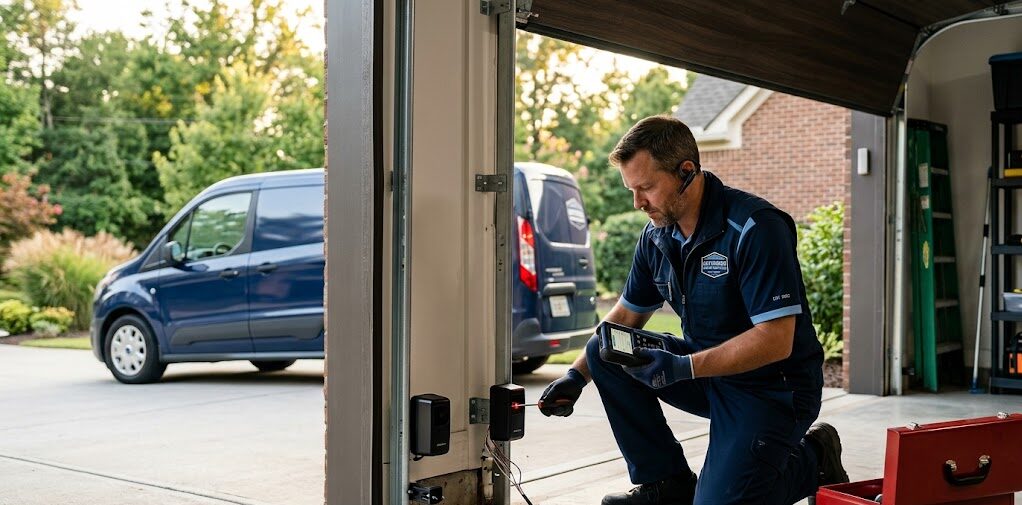
Garage door sensor repair in Chattanooga showing technician testing safety sensors with a signal meter

Garage Door Safety Sensors

Your garage door's safety sensors operate on a modulated infrared frequency, typically 38 kHz, to avoid interference from sunlight and household electronics. When the beam is broken, the receiver stops pulsing, and the opener's logic board must trigger a reversal within 50 milliseconds to meet UL 325 standards. We test this response time using a calibrated interruption device that records the exact moment the door begins to reverse.

But the sensors are only one layer. The opener's internal forceโ€‘sensing clutch must also reverse the door if it strikes an object without breaking the beam. We verify this by placing a 2ร—4 flat on the ground; the door must stop and reverse within two seconds. This dualโ€‘system test โ€” photoelectric and mechanical โ€” is part of every sensor inspection we perform, and we document the results. Regular garage door maintenance service visits include these checks to keep your family safe.
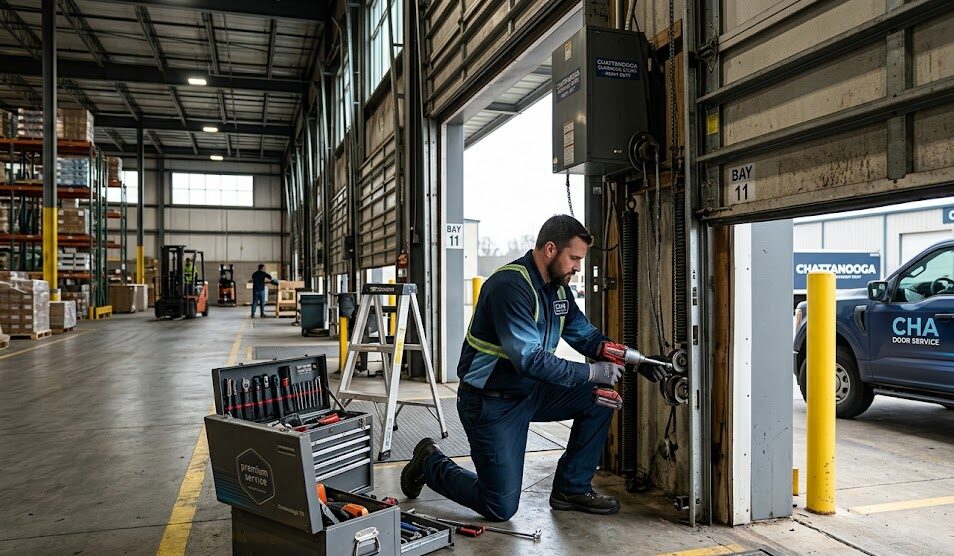
Garage door safety sensor testing and alignment services in Chattanooga TN with technician checking lens clarity

Auto-Reverse Repair

Your opener's autoโ€‘reverse system relies on two independent triggers: the photoelectric beam and the mechanical force sensing. The latter monitors motor current; when the door encounters resistance, current spikes, and the opener immediately reverses. If the forceโ€‘sensitivity adjustment has drifted (common after years of vibration), the door may not reverse until it has already applied dangerous pressure. We recalibrate this setting using the 2ร—4 test and a force gauge.

A broken torsion spring completely undermines the autoโ€‘reverse: the door's weight, no longer counterbalanced, can overload the motor and cause it to continue downward even after striking an obstacle. We always check spring condition and door balance. If the opener's logic board has failed to process the safety signals, a new opener installation may be necessary, but we'll never recommend one without first testing every other component. See our garage door spring repair page for how we handle broken springs.
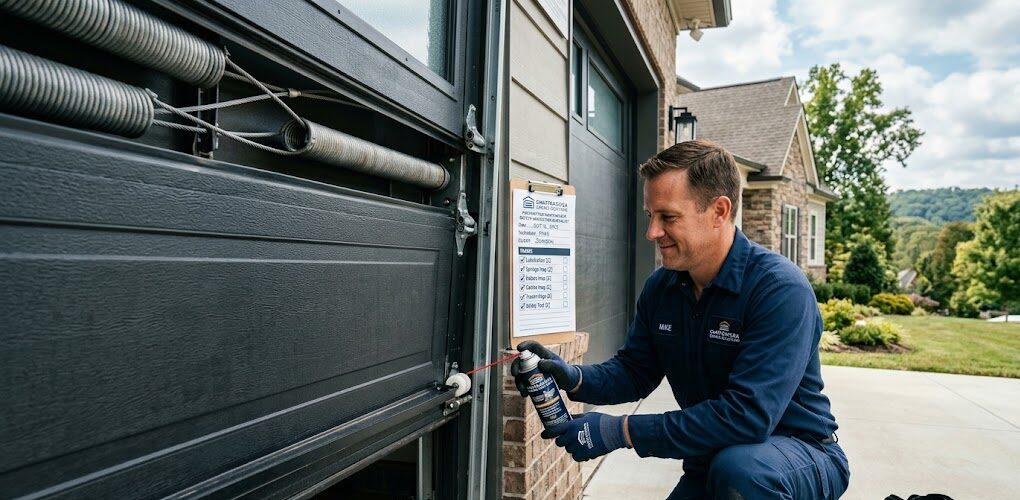
Auto-reverse safety repair and testing in Chattanooga using a 2x4 board to verify compliance

Photo-Eye Sensor Alignment

Proper photoโ€‘eye alignment requires the infrared beam to hit the receiver's photodiode within a 2โ€‘degree cone. Even a slight twist of the vertical track can angle the beam off center. We first verify the track is plumb using a digital level. Then we attach a magnetic laser line to the emitter, aiming it at the receiver, and adjust the bracket's horizontal and vertical tilt until the laser dot falls dead center. This laserโ€‘guided method ensures the beam remains aligned even when the door vibrates during travel.

After alignment, we cycle the door a dozen times to test for any drift. If the sensor consistently loses lock midโ€‘cycle, we inspect the rollers and hinges for wear that's causing the door to shift laterally. In many cases, replacing a single worn roller resolves the intermittent beam break and eliminates the need for repeat sensor adjustments. Our garage door track repair service ensures the track itself isn't bent, which can pull the sensor out of alignment every few weeks.

Photo-eye sensor alignment and adjustment services in Chattanooga with technician using a laser level

Sensor Replacement Services

When we replace safety sensors, we always install a matched pair from the same manufacturer and model line. Mixing brands โ€” even if they fit โ€” can cause signal incompatibility: the emitter's modulation frequency may not match the receiver's sensitivity, leading to intermittent "obstruction" alerts. We verify the new units with a signal tester before buttoning everything up. For homes where the garage faces west, we recommend sensors with enhanced sunโ€‘immune circuitry that filter out the infrared component of direct sunlight, a common cause of false trips in the late afternoon in Chattanooga.

Replacement also gives us the chance to upgrade the lowโ€‘voltage wiring if it shows signs of age or rodent damage. We run new 22โ€‘gauge, 2โ€‘conductor wire through a protective conduit where it crosses open air, and we solder and heatโ€‘shrink every connection to prevent moisture intrusion. After installation, we perform a 10โ€‘cycle endurance test and a full autoโ€‘reverse verification to confirm the system meets current safety standards. If the door's balance or hardware contributed to the original sensor failure, we'll also address cable repair or track repair as needed.

Garage door sensor replacement services in Chattanooga showing new photo-eye units installed

Garage Door Safety Systems

Your garage door's safety system is a chain of interdependent components: the photoโ€‘eyes transmit a "clear" signal to the logic board, which in turn enables the motor to run. The board also monitors the force sensor and the wall button. A single break in this chain โ€” a corroded terminal at the opener, a stuck emergency release cord that prevents the door from contacting the travel limits, or a faulty relay โ€” can disable the entire safety system. Our diagnostic scan covers every link, from the wall button to the sensors, so we pinpoint the exact point of failure.

For commercial properties and multiโ€‘door facilities, we recommend a scheduled garage door maintenance service plan that includes quarterly sensor testing and force recalibration. This not only ensures compliance with OSHA and local codes but also catches issues like a failing capacitor before they cause a breakdown. For homeowners, an annual safety inspection is a small investment that verifies the whole door operates as intended. Check our service areas page for coverage.

Garage door safety systems inspection and repair in Chattanooga TN including force testing

Residential Garage Door Sensors

In a residential setting, the garage door sensors face constant lowโ€‘level abuse. A mower handle catches the bracket, a bicycle falls against the track, or the weekly trash bin rolls past within inches of the photoโ€‘eye. Over time, the plastic housings can crack, letting humidity seep inside and fog the lens from the inside โ€” a problem we see often in Chattanooga's humid summers. We always mount sensors on sturdy steel brackets and use threadโ€‘locking compound on the mounting screws to resist vibration.

We treat your home with respect: we lay down drop cloths, wear shoe covers, and clean up every wire clipping. Our sensor service is an opportunity to inspect the door's entire balance and safety. If a roller has developed a flat spot that's causing the door to hop, we'll let you know and can perform a roller repair at the same time. Likewise, if the cables are frayed, we'll address it before they fail. We'll never upsell โ€” just point out what we see, and you decide.

Residential garage door sensor repair in Chattanooga TN showing technician working on a home opener

Garage Door Diagnostics

Modern openers, like those from LiftMaster and Chamberlain, use a series of LED flashes to communicate fault codes. For example, one flash often indicates a sensor wiring problem, while five flashes point to a motor overheat. But those codes are starting points โ€” we then use a multimeter to measure voltage and continuity, tracing the fault step by step. If the diagnostic code suggests a sensor issue, we temporarily jump the sensor terminals at the opener to see if the door closes normally, which tells us whether the problem is in the sensors and wiring or in the opener's logic board.

A complete diagnostic also includes a thorough mechanical inspection. A single bent hinge or a loose track bracket can cause enough misalignment to break the beam only when the door is at a certain height โ€” a maddening intermittent problem. We physically run the door by hand, feeling for resistance, and check the springs' balance. Once we identify the root cause, we present a clear repair option without jargon. For urgent issues, our opener repair team can often fix it on the spot. Our service areas page shows the communities we cover.

Garage door sensor diagnostics and troubleshooting in Chattanooga with diagnostic tools

Emergency Sensor Repair

When your garage door is stuck open at night, your home is exposed. Before dispatching a technician, we'll walk you through a few simple checks by phone: are both sensor LEDs lit? If one is dark, try wiping the lens and gently realigning the bracket. Is the door's manual release handle pulled? Sometimes, reโ€‘engaging the trolley solves the problem. If the door remains inoperable, we'll have a truck rolling within the hour.

We stock the most common sensor modules, wire, and hardware for immediate replacement. More than half of our emergency calls uncover a secondary issue โ€” a broken garage door spring that allowed the door to crash down onto an object, bending the sensor bracket and shorting the wire, or a frayed cable that snapped under the extra load. We address the emergency first: get the door closed and secured, then present a plan for any necessary followโ€‘up repairs. Our sameโ€‘day response covers all of Hamilton County and North Georgia, and we'll never charge extra for afterโ€‘hours service that's genuinely an emergency.

Emergency garage door sensor repair services in Chattanooga TN, same-day response

Chattanooga Garage Door Services

From a quick sensor realignment to a complete safety system overhaul, our Chattanooga team handles every aspect of garage door safety. We work on beltโ€‘drive and chainโ€‘drive openers, highโ€‘lift commercial tracks, and residential systems in homes from North Chattanooga to Apison. Every technician is a local employee โ€” not a subcontractor โ€” and carries full insurance for your peace of mind.

When you call us for a sensor issue, you get access to the full range of garage door services. If a misaligned door has been chewing up rollers, we can perform a roller replacement on the spot. If a frayed cable is close to breaking, we'll replace it before it snaps. Our spring repair, opener installation, track repair, and cable repair services are all available as needed, and we include a basic safety inspection with every visit. Browse our service areas page to see the neighborhoods we serve, or contact us for a free, noโ€‘pressure estimate.

Chattanooga garage door sensor repair services showing professional technician at a home

Frequently Asked Sensor Repair Questions

Straight answers from a team that has diagnosed thousands of garage door sensors across Hamilton County โ€” no sales pitch, just the truth.

  • If your door travels down a few inches then reverses, or refuses to budge from the open position while the opener light blinks, the safety sensors are the first place to look. The opener's logic board interprets a broken infrared beam as an obstruction and locks out the close cycle. In Chattanooga, we often find the beam interrupted by a tiny spiderweb strung across the lens, fine dust from a recent lawn mowing, or a sensor bracket that got nudged when a trash can was pulled out. A quick homeowner test: press and hold the wall button (not the remote). If the door closes while you hold the button, you have confirmed a sensor-related issue โ€” the opener is bypassing the beam safety. However, never leave the door operating in this override mode; it's for temporary testing only. When we arrive, we measure DC voltage at the sensor terminals, check beam strength with a calibrated target, and verify the opener's force settings haven't drifted, which can also cause false reversals. More than once we've found a single staple, driven through the lowโ€‘voltage wire inside the wall, that was shorting the circuit only when humidity spiked.

  • Blinking sensor LEDs are your opener's selfโ€‘diagnostic language. A steady, slow blink (on LiftMaster or Chamberlain units) usually means the sending and receiving eyes are not seeing each other. Check for anything physically blocking the beam path โ€” even a bicycle tire leaning against the track. A rapid blink often indicates a wiring short, perhaps from a staple that pierced the insulation or a connector that has corroded from the damp concrete floor. In Chattanooga's summer, morning condensation can bead on the lens and scatter the infrared beam just enough to trigger a blink; wiping both lenses with a dry microfiber cloth can sometimes restore a solid light. If the LED is completely dark, power isn't reaching the sensor. We then test voltage at the opener terminal and at the sensor. A common culprit we see in westโ€‘facing garages is lowโ€‘angle afternoon sun blinding the receiver. Older sensors lack sunโ€‘immune circuitry, and the direct sunlight overwhelms the modulated signal. If shading the sensor makes the blink stop, we can often install a small sun shield or replace the unit with a sunโ€‘immune model.

  • Absolutely, and in many cases repair is faster and more costโ€‘effective than replacement. The sensor assembly is not a single sealed component โ€” it consists of a bracket, a lens, an infrared emitter or receiver, and a small circuit board. We can restore alignment, clean a fogged lens with plasticโ€‘safe polish, tighten a loose bracket with lock washers, and solder a broken wire. Even when one sensor is internally damaged, we can often replace just that unit without replacing the entire pair. However, if water has seeped inside and corroded the circuit traces โ€” something we see after a Chattanooga thunderstorm drives rain under the door โ€” or if the photodiode has degraded to the point where its signal strength is below the opener's threshold, replacement becomes the only reliable option. We always test with a multimeter and a signal strength gauge before recommending any part purchase, and we'll show you the readings so you understand why a replacement is necessary.

  • Several signs point toward replacement rather than repair. The clearest is a sensor that shows no LED light at all, even after confirming power is present at the terminals with a multimeter. A lens that is internally fogged โ€” condensation trapped inside the sealed housing โ€” can't be cleaned from the outside and scatters the beam permanently. Hairline cracks in the plastic allow humidity to enter, leading to corrosion. We also measure the emitter's signal strength: over time, the infrared LED can fade, and the beam becomes too weak for the receiver to detect reliably, causing intermittent obstructions. If the sensor is more than 15 years old and you are already experiencing repeated issues, proactive replacement with a matched pair of sunโ€‘immune sensors is a wise investment. We never push a replacement without first showing you the measured evidence โ€” whether it's a failed voltage test or a signal strength reading below the manufacturer's specification.

  • Your opener has two separate autoโ€‘reverse systems, and either one can fail. The first is the photoelectric sensor system: if the beam is broken while closing, the door must reverse instantly. The second is the mechanical forceโ€‘sensing circuit inside the opener: it monitors the motor's current draw, and if the door hits an object that doesn't break the beam (like a child's toy or a lowโ€‘profile box), the spike in current triggers a reversal. When your door reverses for no apparent reason, the force setting may be too sensitive, or a binding track is creating false resistance. When it fails to reverse on contact, the force setting is too high or the sensors aren't communicating. We test with a 2ร—4 laid flat: the door must reverse within two seconds. We also check the door's balance; if a broken spring makes the door heavy, the opener may not have enough torque to reverse properly. We calibrate the force potentiometer with a torque gauge to restore the proper sensitivity, ensuring both safety systems work independently.

  • Yes, and wiring faults are surprisingly common. The 22โ€‘gauge, 2โ€‘conductor lowโ€‘voltage wire that runs from the opener motor to the sensors is often stapled to the wall or ceiling. Over time, a staple can cut into the insulation, creating a short that behaves intermittently with temperature or vibration. Rodents chewing the wire inside the wall is another frequent issue in Chattanooga garages, as is corrosion at the screw terminals near the damp concrete floor. We use a digital multimeter to perform a continuity test from the opener terminal to the sensor, and a voltageโ€‘drop test under load to identify highโ€‘resistance connections. When we find a fault, we don't just twist and tape โ€” we solder the splice and seal it with adhesiveโ€‘lined heatโ€‘shrink tubing to keep moisture out. If the wire run is old and brittle, we replace the entire length with new, stapleโ€‘resistant cable, routing it through a protective conduit where it crosses exposed areas.

  • Absolutely. A garage door stuck in the open position โ€” especially at night or during a storm โ€” is a security and safety emergency. We prioritize these calls and can often dispatch a technician to your home within a few hours. While you wait, we'll walk you through a few phone checks: if the wall button closes the door (bypassing the sensors), you can secure the door that way as a temporary measure, but only if you can verify the door's path is completely clear. However, never rely on this override longโ€‘term. Our trucks carry common sensor modules, wiring supplies, and diagnostic tools, so we can fix the problem on the spot in most cases. We also understand that emergencies don't just happen to residential doors; if your commercial loading dock door is stuck, we have experience with highโ€‘cycle commercial sensors and can restore operation quickly.

  • We cover the entire Chattanooga metro area โ€” from downtown and Northshore to Hixson, East Brainerd, Ooltewah, Signal Mountain, Soddyโ€‘Daisy, Red Bank, and across the state line into Ringgold, Fort Oglethorpe, Rossville, Chickamauga, and all surrounding North Georgia communities. Our technicians are local; they live in these neighborhoods and understand the specific garage door challenges each area faces โ€” for example, the red clay dust that coats sensor lenses in Ooltewah, or the lowโ€‘angle winter sun that blinds westโ€‘facing sensors on Lookout Mountain. For a complete list and to see if your specific street is in our daily service area, visit our service areas page. If you're unsure, call us โ€” chances are we were on your street last week.

Chattanooga Sensor Specialists

Schedule Your Garage Door Sensor Repair in Chattanooga Today

When that sensor LED blinks and the door refuses to close, you need a fix backed by real diagnostics โ€” not a quick wipe and a hope. Our technicians arrive with laser alignment tools, digital multimeters, and infrared signalโ€‘strength meters. We check DC voltage at the sensor terminals, confirm the beam is hitting the receiverโ€™s photodiode dead center, and test the openerโ€™s forceโ€‘sensitivity circuit with a 2ร—4 block to ensure the autoโ€‘reverse works within the ULโ€‘required two seconds. Even hidden wiring faults โ€” like a staple that pierced the lowโ€‘voltage wire inside the wall โ€” wonโ€™t escape our continuity test. Whether your home is on Signal Mountain, in East Brainerd, or across the line in Ringgold, Chattanooga Garage Doors Pro delivers the same thorough diagnostic and repair. And we back it with our fullโ€‘service guarantee. One visit, one straightโ€‘forward estimate, and a garage door that closes safely every time.

  • Licensed, Insured & UL 325 Compliant
  • Sameโ€‘Day Instrumented Diagnostics
  • OEM Sensors & Soldered Wiring
  • Free Estimates, No Hidden Fees