Garage Door Track Bent? What Should You Do?
You're pulling out of the driveway when you notice it — the garage door is hanging at a strange angle, and one of the vertical tracks has an obvious kink in it. Or maybe you bumped the track with your car bumper last week, and now the door grinds and shudders every time it moves. A bent garage door track is one of the most common — and most dangerous — problems homeowners face. In Chattanooga and across the Tennessee Valley, we see bent tracks every week, and the outcome depends almost entirely on how quickly the homeowner responds. Wait too long, and a minor bend becomes a door that's off track, a damaged panel, and a repair bill three times higher than it needed to be.
This guide will walk you through exactly what to do when you discover a bent track — the immediate safety steps, the signs that distinguish a minor bend from a serious structural problem, whether it can be straightened or needs replacement, and what the repair actually costs. If you're also dealing with a door that's come off the track entirely, our guide on garage door tracks: common problems and solutions covers the full range of track issues.

First: Stop Using the Door Immediately
This is the single most important step, and it's the one homeowners most often skip. A bent track is not a "use it gently until I get around to it" problem. The moment a track bends, the geometry of the entire door system changes. The rollers no longer travel in a straight line. The door's weight shifts onto the remaining track and the opener. Every cycle you run accelerates the damage — bending the track further, wearing the rollers unevenly, straining the opener motor, and increasing the risk that the door comes off the track entirely.
A door that comes off a bent track can fall. A 150- to 300-pound door falling on a person, a car, or a pet is a catastrophic event. Do not press the remote. Do not pull the emergency release cord — on a bent track, the door may not be balanced, and releasing it manually can cause it to drop. Unplug the opener so no one in the household can activate it by accident. Then keep the area clear and call a professional.
What Causes a Garage Door Track to Bend?
Understanding the cause helps you prevent the next one. In our experience, bent tracks fall into five categories:
- Vehicle impact. This is the number one cause. A car, truck, or SUV bumper taps the vertical track while pulling in or out of the garage. Even a low-speed bump can push the track out of alignment or put a visible kink in the steel. If you share a garage with a teenager learning to drive, this is almost inevitable.
- Door coming off track. When a roller jumps out of the track — usually due to a worn roller, a broken cable, or a failed hinge — the door's weight can land on the track itself and bend it. This is the most severe category because the bend is usually accompanied by other damage.
- Loose mounting bolts. The bolts that secure the track to the wall and the door frame can loosen over years of vibration. A track that has shifted slightly can then be bent by the door's normal movement.
- Foundation settling. Chattanooga's clay soil expands and contracts with the seasons, and older garages can shift over time. When the garage structure moves, the track mounting points can move with it, putting stress on the tracks.
- Impact from stored items. A ladder, a bike, or a piece of lumber leaning against the track can bend it over time, especially if the item shifts and pushes inward.
Knowing which of these applies to your situation helps the technician determine whether the track is the only problem or whether there's an underlying issue — like a failing spring or a broken cable — that needs to be addressed at the same time.
How to Assess the Damage (From a Safe Distance)
Once you've stopped using the door, you can safely inspect the track from a distance. Do not touch the track, the door, or the springs. The goal here is to gather information for the technician — not to attempt a repair.
Look at the vertical track on each side of the door, from about six feet back. A healthy track is a straight, clean line of steel. A bent track will show a visible kink, curve, or angle where the metal deviates from straight. Also check the horizontal tracks overhead — these are less commonly bent but can be damaged if the door comes off track. Then look at the rollers. If any roller is out of the track, or if the door panel is visibly separated from the track, that's a serious situation. Finally, look at the door itself — is it level? If one side is higher than the other, the door is off balance, which usually means the track problem is affecting the door's movement.
Can a Bent Track Be Straightened, or Does It Need Replacement?
This is the question every homeowner asks, and the honest answer is: it depends on the bend. Track straightening is possible in some cases, but it's not always the right call. Here's how to think about it:
Minor bends — a gentle bow or a slight deviation of a quarter-inch or less, with no crease in the metal — can sometimes be straightened. A technician will use a wood block and a rubber mallet, or in some cases a hydraulic tool, to coax the steel back to true. The key word is "sometimes." Even a minor bend leaves the metal fatigued at that point, and the track may bend again in the same spot within a year.
Moderate bends — a visible kink or angle, but no crack in the metal — are borderline. Some technicians will attempt a straighten, but most will recommend replacement. The cost difference between straightening and replacing a track section is modest, and a new section restores the track to factory tolerance.
Severe bends — a sharp crease, a crack, a split in the steel, or a bend that's displaced the track more than an inch from its original position — always require replacement. The metal has lost its structural integrity at that point. Straightening it is not possible, and even if it were, the track would fail again within weeks. This is especially true for the bottom section of the vertical track, where the cable and the door's full weight are concentrated.
A general rule we use: if the bend is visible from across the garage, it's a replacement. If you have to get up close and squint to see it, it might be straightenable. When in doubt, replace. A new track section is $40 to $120 — far less than the cost of a door that falls or a panel that gets damaged.
How Much Does Bent Track Repair Cost?
Track repair costs depend on whether the track can be straightened or needs replacement, and whether the bend has caused secondary damage to the rollers, hinges, or door panels. Here's what to expect in the Chattanooga area:
| Repair Type | Typical Cost |
|---|---|
| Track straightening (minor bend) | $125–$200 |
| Replacing one vertical track section | $150–$300 |
| Replacing both vertical tracks | $250–$400 |
| Replacing horizontal tracks (both sides) | $300–$500 |
| Full track replacement (all four sections) | $400–$700 |
| Bent track + off-track door repair | $300–$600 |
Parts alone for a track section run $40 to $120, depending on the door size and track gauge. Labor is typically $75 to $150 per hour, and most track repairs take one to two hours. If the bend has damaged the rollers, add $50 to $150 for a full roller replacement — and if you're replacing rollers anyway, it's worth upgrading to nylon or sealed-bearing rollers for quieter, longer-lasting operation. Our guide on garage door rollers: nylon vs steel explains the differences.
If the bend is the result of a broken spring or cable, those repairs are additional. Spring replacement typically runs $200 to $700, and cable replacement runs $150 to $300. Our guide on garage door spring replacement cost breaks that down in detail.
Can You Fix a Bent Track Yourself?
The short answer is: no. Not safely. Bent track repair is not a DIY task, and here's why. The track is under load from the door's weight and the spring tension, and the alignment tolerances are measured in fractions of an inch. A track that's off by a quarter-inch will cause the rollers to bind, the door to jerk, and the opener to strain — and within weeks, you'll have the same problem again, only worse.
The risks of a DIY straightening attempt are significant. If you release the door's tension incorrectly, the door can fall. If you bend the track back with too much force, you can crease the metal and make the damage permanent. If you accidentally bump the torsion spring or the cables while working near the track, you can trigger a catastrophic release. Homeowners are seriously injured every year attempting garage door repairs that should have been left to a professional.
What you can do safely: keep the area clear, unplug the opener, document the damage with photos so you can describe it accurately when you call, and gather the model number of your door and opener so the technician can bring the right parts. If you're wondering whether a bent track qualifies as an emergency, our guide on emergency garage door repair signs explains which symptoms require immediate action.
How a Professional Repairs a Bent Track
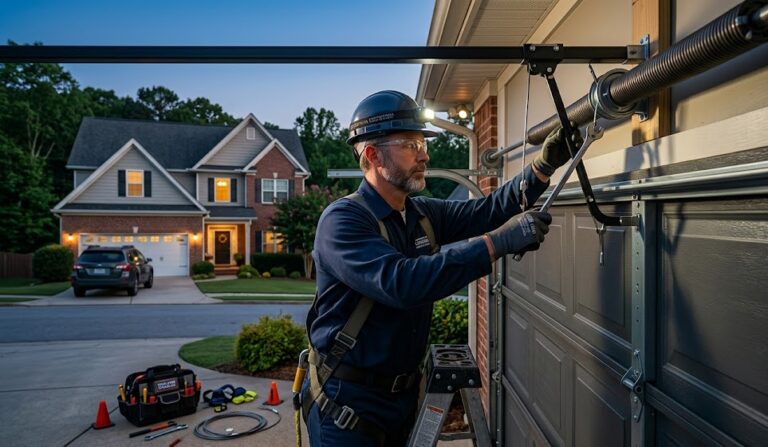
When a licensed technician arrives to repair a bent track, the job involves more than just bending the metal back. Here's what a proper repair looks like:
- Secure the door. The technician will lock the door in place with C-clamps or locking pliers on the track, and may release the spring tension if the repair requires it.
- Assess the full system. Before touching the track, the technician checks the springs, cables, rollers, and hinges to determine whether the bend is the only problem or a symptom of a deeper issue.
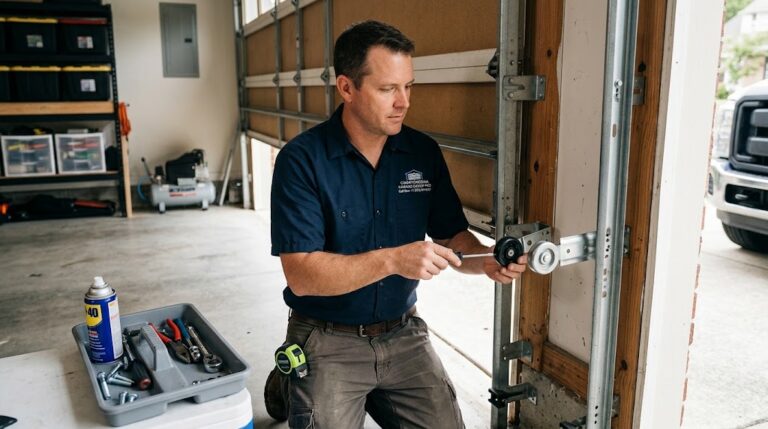
- Replace or straighten the track. If the bend is minor, the technician may straighten it with the proper tools. If it's moderate or severe, the track section is replaced with a new one matched to the door's gauge and size.
- Realign the system. Both vertical tracks must be plumb, and both horizontal tracks must be level and parallel. This is measured with a level and a tape — a few degrees of misalignment will cause the door to bind.
- Check and replace worn rollers. A bent track usually damages or wears the rollers. Most technicians will replace the full set at the same time to ensure even operation.
- Test the full cycle. The door is run through several full open-close cycles, and the safety reverse system is tested. The technician won't leave until the door operates smoothly and the balance is correct.
This comprehensive approach is why a professional repair usually lasts. A quick bend-and-go leaves hidden problems that surface weeks later. If you're wondering how to find a reliable technician, our guide on how to choose the best garage door company in Chattanooga walks you through the questions to ask.
Prevention: How to Avoid Bending a Track Again
Most bent tracks are preventable. Here's what we recommend to homeowners after a track repair:
- Clear the garage entry path. Mark or tape the area near the vertical tracks so drivers know how much clearance they have. A tennis ball hanging from the ceiling, positioned to touch the windshield at the right stopping point, is a classic and effective trick.
- Keep stored items away from the tracks. Don't lean ladders, bikes, or lumber against the vertical tracks. Even a small amount of sustained pressure can bend the steel over time.
- Check the mounting bolts twice a year. With the door closed, check every track bolt with a socket wrench. Tighten any that are loose. Loose bolts are the leading cause of gradual track misalignment.
- Replace worn rollers promptly. A worn roller can jump the track and bend it. If your rollers are more than 7 years old or show any wobble, replace them. Our guide on garage door rollers: nylon vs steel can help you choose replacements.
- Keep the door balanced. An unbalanced door puts uneven stress on the tracks. Test the balance annually by disconnecting the opener and lifting the door halfway — it should stay in place.
- Schedule an annual tune-up. A professional inspection catches track misalignment and early bends before they become a failure. Our seasonal garage door maintenance guide for Chattanooga homes explains what to check each season.
For more troubleshooting tips and maintenance advice, browse our blog.
Frequently Asked Questions
1. Can I still use my garage door if the track is bent?
No. Stop using the door immediately. A bent track changes the door's geometry, strains the opener, and increases the risk that the door comes off the track and falls. Unplug the opener so no one can activate it, keep the area clear, and call a professional.
2. Can a bent track be straightened, or does it need to be replaced?
It depends on the severity. A minor bend with no crease can sometimes be straightened, but the metal is fatigued and may bend again. A moderate or severe bend — a visible kink, crease, crack, or displacement over an inch — always requires replacement. When in doubt, replace. A new track section is $40 to $120.
3. How much does bent track repair cost?
Straightening a minor bend costs $125 to $200. Replacing one vertical track section costs $150 to $300. Replacing both vertical tracks costs $250 to $400. Full track replacement (all four sections) runs $400 to $700. If the bend has caused other damage, like worn rollers or an off-track door, the total will be higher.
4. Is a bent track an emergency?
Yes. A bent track is a structural failure that can lead to a door falling off the track and dropping. It's not a repair you can defer. Call a licensed technician the same day. If the door is stuck open, your home is also exposed — our guide on emergency garage door repair signs explains the urgency.
5. Can I fix a bent track myself with a hammer?
No. Attempting to hammer a track straight while it's under the door's weight and spring tension is dangerous. You can crease the metal and make the damage permanent, or worse, cause the door to fall. Track repair requires proper tools, alignment measurement, and the ability to safely release and reset spring tension. Call a professional.
6. How can I prevent my track from bending again?
Mark your parking clearance so you don't bump the track, keep stored items away from the tracks, check the mounting bolts twice a year, replace worn rollers promptly, and schedule an annual professional tune-up. Most bent tracks come from vehicle impact or worn rollers — both are preventable.
A Bent Track Only Gets Worse — Get It Fixed Today
A bent garage door track is not a "wait and see" problem. Every cycle you run on a bent track increases the damage, strains the opener, wears the rollers, and raises the odds that the door comes off the track and falls. In Chattanooga, Hixson, East Ridge, and Ooltewah, our licensed technicians repair bent tracks every week — straightening minor bends, replacing damaged sections, realigning the full system, and replacing worn rollers in a single visit. We test the door through multiple cycles before we leave, and we never charge hidden fees. Call now to schedule your track repair — the sooner you call, the less it costs.
Call (423) 564-8231