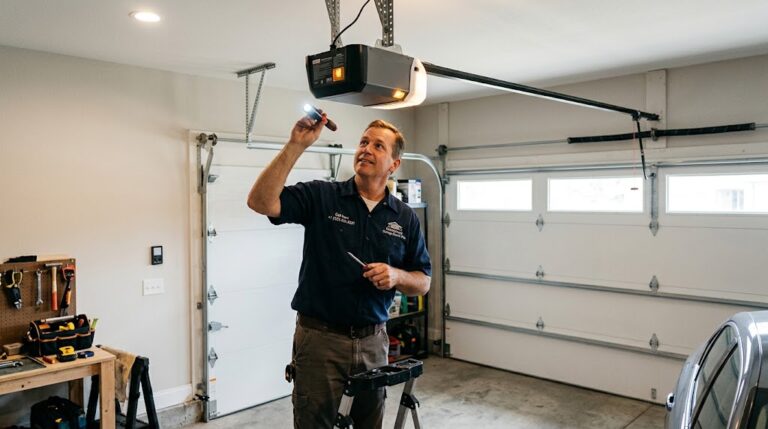
Garage Door Chain or Belt: Which Is Better?
If you’re shopping for a new garage door opener — or your old one finally gave out after fifteen years of service — you’ve probably noticed that the biggest decision isn’t the brand. It’s the drive system. Chain or belt? Walk into any home improvement store in Chattanooga and you’ll see both options side by side, often with a price gap that makes the choice feel obvious. But the cheaper option isn’t always the better one, and the quieter option isn’t always worth the premium. The right answer depends on where your garage sits in relation to the rooms you actually live in, how long you plan to stay in the house, and how much noise you’re willing to tolerate every single time the door moves.
This guide breaks down the real differences between chain-drive and belt-drive openers — noise, durability, maintenance, cost, and lifespan — so you can make a decision based on your home rather than a marketing label. If you’re also weighing a full opener replacement, our guide to garage door installation cost in Chattanooga TN will help you budget for the whole project.
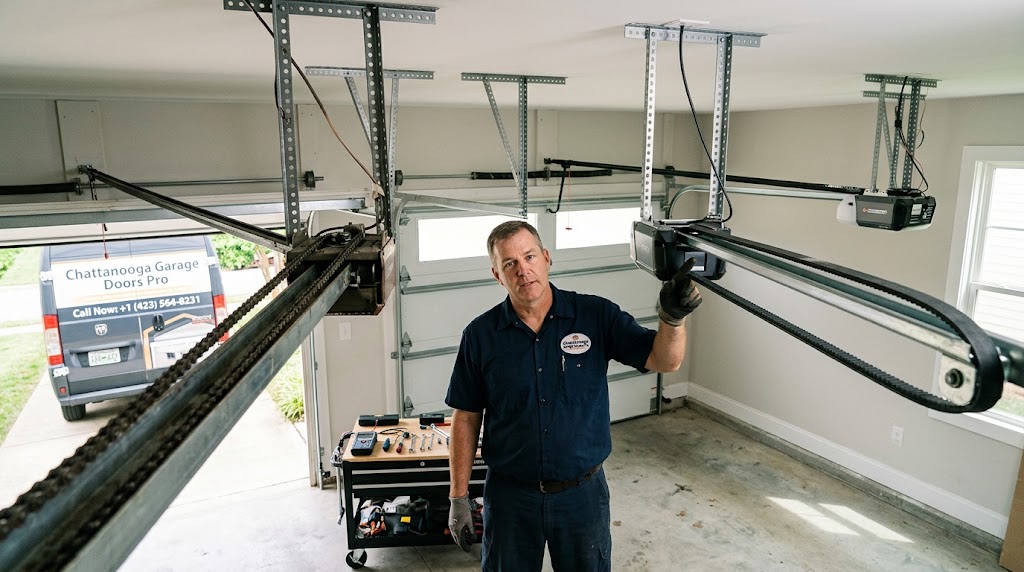
The Two Drive Systems, Explained Simply
Every automatic garage door opener uses a motor to pull a trolley along a rail, and that trolley is connected to the door. The drive system is simply the mechanism that transfers power from the motor to the trolley. There are two dominant types in residential use today, and a third — screw drive — that occupies a smaller niche.
Chain drive uses a metal roller chain — essentially a heavy-duty bicycle chain — running along a steel rail. The motor turns a sprocket, the sprocket moves the chain, and the chain pulls the trolley. It’s the oldest and most proven design in the industry, and it’s the one most homeowners recognize. Belt drive replaces the chain with a reinforced rubber belt, typically with steel cords molded inside for strength. The motor turns a pulley instead of a sprocket, and the belt moves the trolley with far less metal-on-metal contact. Screw drive, for completeness, uses a threaded steel rod that the trolley rides along as it rotates. It’s the least common of the three in newer homes but still found in some builder-grade installations.
Noise: The Biggest Practical Difference
This is the difference most homeowners notice immediately, and it’s the single strongest argument for belt drive. A chain drive produces a mechanical rattle as the metal chain rolls through the sprocket and slides against the rail. In a detached or well-isolated garage, that noise is barely noticeable. But in a modern home where the master bedroom sits directly above the garage, or where a nursery shares a wall with the garage, a chain drive at 6 AM is genuinely disruptive. Belt drives eliminate the metal-on-metal contact entirely. The result is a smooth, low hum rather than a rattle — typically 10 to 20 decibels quieter than an equivalent chain unit. That’s roughly the difference between a normal conversation and a refrigerator running.
One important caveat: the drive system is only part of the noise equation. A belt drive attached to a poorly maintained door will still be loud, because the noise is coming from the door itself — worn rollers, dry hinges, and loose hardware. If your current door rumbles and squeals, replacing the opener alone won’t solve it. Lubricating the rollers and hinges, and replacing worn rollers, will do more for overall quietness than any drive-system upgrade. If your opener is making unusual sounds, our guide on garage door opener light blinking explains how the opener communicates problems through its diagnostic codes, and our guide on garage door makes clicking noise but won’t open covers what different mechanical sounds actually mean.
Durability and Lifespan
Here the conventional wisdom gets a little more complicated than most articles admit. Chain drives are often described as “more durable” because steel is stronger than rubber. That’s true in isolation, but it doesn’t tell the whole story. A steel chain under tension in a humid garage will eventually stretch, and a stretched chain is the single most common chain-drive failure. It causes the door to jerk, produces a slapping sound, and eventually jumps the sprocket. Chains also require periodic lubrication, and in Chattanooga’s humid climate, an unlubricated chain rusts and wears faster than you’d expect.
Belt drives avoid stretching entirely. The steel cords inside the belt don’t elongate the way a chain does, so the door travel stays consistent for years. Belts also don’t rust. The trade-off is that belts can dry out, crack, or fray over time, particularly in garages with extreme temperature swings. A belt typically lasts 10 to 15 years; a well-maintained chain can last 15 to 20. In practice, both systems usually outlive the opener’s logic board and motor, which tend to fail first. If you’re experiencing electronic rather than mechanical failures, our guide on garage door won’t open with remote walks through the most common electronic culprits.
Maintenance Requirements
Chain drives need lubrication roughly once or twice a year. Use a white lithium grease or a dedicated chain lubricant — not WD-40, which is a solvent rather than a lubricant and will actually strip the grease you want to keep. The rail should also be wiped down periodically to remove grit. Belt drives need almost nothing. An occasional inspection for fraying or cracking is sufficient, and some manufacturers recommend a light application of silicone spray on the belt to keep the rubber supple. If you’re the kind of homeowner who wants to set it and forget it, belt drive is the lower-effort option.
Whatever drive system you choose, the door itself needs maintenance regardless. Springs, rollers, hinges, and tracks are common to both systems and wear at the same rate. Our seasonal garage door maintenance guide for Chattanooga homes lays out a simple checklist you can follow twice a year.
Cost: Where the Decision Usually Gets Made
Belt drives cost more. That’s the bottom line. For a comparable opener with the same horsepower, the same safety features, and the same smart connectivity, you’ll typically pay $50 to $100 more for belt drive than for chain. In terms of installed cost, a belt-drive unit generally runs $250 to $450 for the opener itself, while a chain-drive unit of similar quality runs $170 to $350. Screw drive sits in between.
Whether that premium is worth it depends entirely on where your garage is relative to your living space. If the garage is detached, or if there’s a hallway, a closet, and a solid insulated wall between the garage and the nearest bedroom, chain drive is the sensible choice. Save the money and put it toward better door insulation or a stronger spring. But if the garage shares a wall with a bedroom, a nursery, or a home office — which describes a large share of newer Chattanooga-area construction — the extra $50 to $100 for belt drive pays for itself in sanity within the first month.
Chain vs. Belt at a Glance
| Factor | Chain Drive | Belt Drive |
|---|---|---|
| Noise Level | Louder — mechanical rattle | Quieter — smooth hum, 10–20 dB less |
| Durability | 15–20 years with lubrication | 10–15 years, no stretching |
| Maintenance | Lubricate 1–2x per year, rail cleaning | Minimal — occasional inspection |
| Cost (opener only) | $170–$350 | $250–$450 |
| Best For | Detached garages, budget builds, heavy doors | Attached garages, bedrooms above, high-use homes |
| Weather Resistance | Rusts if unmaintained | Unaffected by humidity, cracks with age |
What About Screw Drive?
Screw drive is the forgotten third option, and it deserves a brief mention. It uses a threaded steel rod that rotates inside the trolley, pulling it along the rail. It’s louder than belt but usually quieter than chain, requires less maintenance than chain because there’s no chain to lubricate, and handles extreme cold better than either — the threaded rod doesn’t stiffen the way a rubber belt does, and it doesn’t stiffen the way a chain does. Genie is the primary manufacturer still producing screw-drive units in volume. The downside is that screw drives can be fussy about alignment, and if the rod gets dirty or dry, the door will grind and shudder. They’re a reasonable choice for a detached garage in a cold climate, but they’re not the default recommendation for most Chattanooga homes.
So Which Should You Choose?
Here’s the simple decision framework we use with homeowners every week:
- Choose belt drive if the garage is attached to the house, there’s a bedroom, nursery, or home office above or adjacent to the garage, you use the door multiple times a day, or you plan to stay in the home long-term and want the quietest possible operation.
- Choose chain drive if the garage is detached, the nearest sleeping area is separated by several walls, you’re on a tight budget, or you’re installing an opener in a rental property where longevity and low upfront cost matter more than quietness.
- Choose screw drive if you’re in an area with severe winters and you want the cold-weather reliability without the noise of a chain. It’s a niche pick, but a valid one.
One factor that matters more than most buyers realize: horsepower. A single ½ HP opener is adequate for a standard single-car door, but a double-car door or a heavy insulated door needs ¾ HP or more, regardless of drive type. An underpowered belt drive will strain and fail far sooner than a properly sized chain drive. Match the horsepower to the door first, then choose the drive system. And whatever you choose, make sure you’re comparing openers with the same features — modern smart garage door openers include WiFi connectivity, rolling code security, and battery backup, and those features often matter more to daily life than the drive type.
Installation Considerations
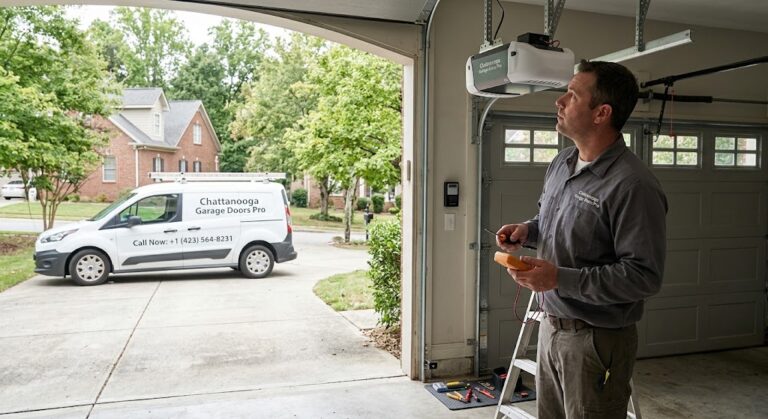
Both drive systems install the same way — the opener head mounts to the ceiling, the rail extends to the door header, and the trolley connects to the door’s drawbar. The rail length differs, so the opener must be matched to your garage depth. Belt drives are slightly more sensitive to installation alignment; a misaligned belt will wear unevenly and fray at the edges, while a chain will tolerate a bit more slop before it complains. This is one reason we recommend professional installation for belt-drive units, even for handy homeowners. A chain drive installed slightly off-center will make noise; a belt drive installed off-center may fail within a year.
If you’re replacing an existing opener, the electrical outlet is usually already in place, which simplifies the job considerably. New construction or a garage that’s never had an opener will need a dedicated outlet near the opener head — ideally on the ceiling. A licensed electrician should handle that part. For the opener installation itself, a licensed garage door technician can typically complete the job in two to three hours, including programming the remotes and testing the safety reverse system. If you’re deciding whether to repair your current opener or replace it, our guide on when to call a garage door technician covers the trade-offs, and our guide on how to choose the best garage door company in Chattanooga will help you find a reputable installer.
Frequently Asked Questions
1. Is a belt drive really worth the extra cost?
If your garage is attached to your home and there’s a bedroom or living space nearby, yes. The noise reduction is significant and immediately noticeable. If your garage is detached or well-isolated, a chain drive will serve you just as well for less money.
2. Which lasts longer — chain or belt?
A well-maintained chain typically lasts 15–20 years; a belt typically lasts 10–15. In practice, the opener’s motor and logic board usually fail first, so the drive system rarely determines the unit’s overall lifespan.
3. Can I convert a chain drive to a belt drive?
Generally no. The sprocket, rail, and trolley are designed for one specific drive type. Conversion kits exist for a few models, but they’re rarely cost-effective. Replacing the entire opener is usually the better option.
4. Does a belt drive need lubrication?
No. Belts are self-lubricating and should never be greased — grease attracts grit that accelerates wear. A light silicone spray once a year is all some manufacturers recommend, and many require nothing at all.
5. What horsepower do I need?
A ½ HP opener handles a standard single-car door. A double-car door, a heavy insulated door, or a door with a lot of glass needs ¾ HP or more. Match the horsepower to the door first, then decide between chain and belt.
6. Which is better in cold weather?
Screw drive handles extreme cold best. Belt drives can stiffen in very low temperatures, and chains can bind if the lubricant thickens. In Chattanooga’s climate, this is rarely a deciding factor — both chain and belt perform well year-round.
Not Sure Which Is Right for Your Garage?
The chain-versus-belt decision depends on details only you can see — how close your bedroom is to the garage, how often the door runs, how long you plan to stay in the home, and what your budget allows. In Chattanooga, Hixson, East Ridge, and Ooltewah, our licensed technicians install both types every week and can give you a straight recommendation based on your actual garage — not a sales pitch. We’ll tell you honestly if a chain drive will do the job just as well, and we’ll match the opener’s horsepower to your door so it lasts. Call now to schedule a consultation or a same-week installation.
Call (423) 564-8231