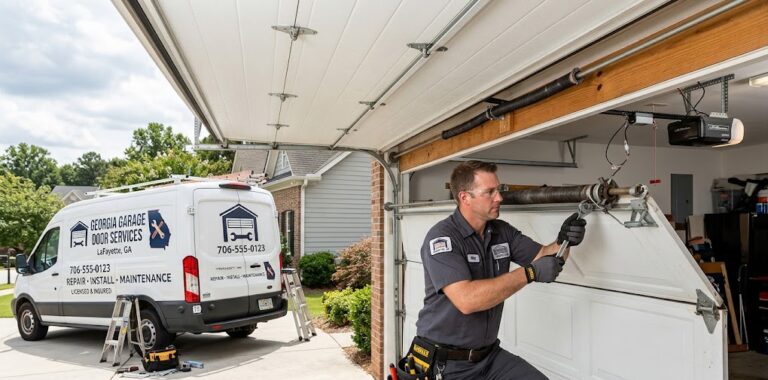
Garage Door Stops Halfway? Causes and Fixes
It happens at the worst possible time. You press the button, the door lurches upward, rises a few feet, and then just… stops. Maybe it hangs there and hums. Maybe it reverses and drops back down. Either way, your car is trapped, your garage is exposed, and you’re left staring at a door that seems to have given up halfway through the job. A garage door that stops halfway is one of the most common service calls we get in Chattanooga and across the Tennessee Valley. The good news is that the cause almost always falls into a short list of fixable problems. The better news is that you can often narrow it down yourself in about five minutes.
A garage door that stops mid-travel is telling you one of three things: the opener is sensing too much resistance and hitting a safety stop, something is physically blocking or binding the door, or the lifting mechanism — the spring, cable, or opener — is weakening. The specific cause determines the fix, and in many cases, the difference between a simple adjustment and a major repair comes down to knowing what to look for. This guide will walk you through the most likely causes, show you which fixes are safe to try yourself, and explain when it’s time to call a licensed technician.
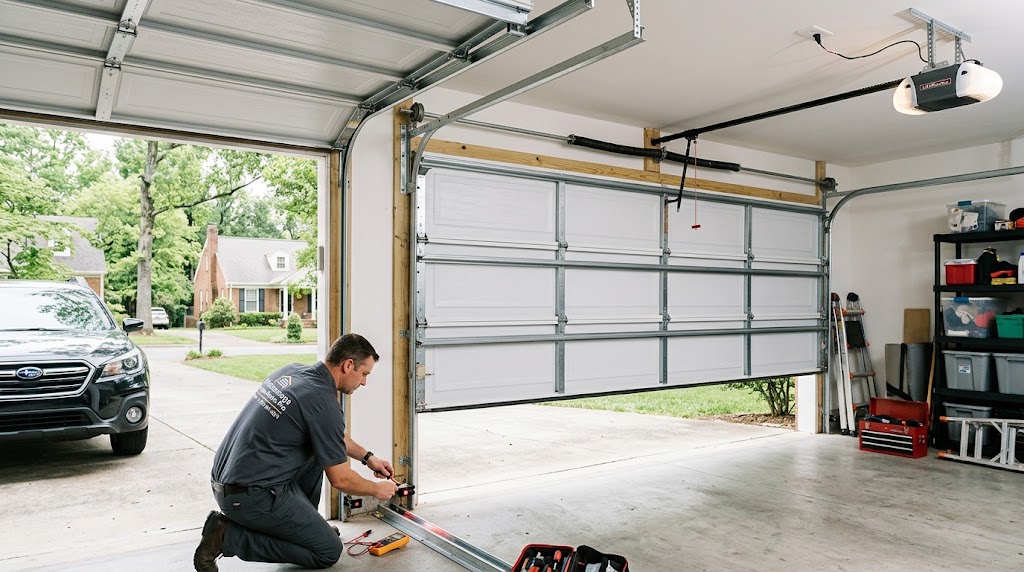
Why Your Garage Door Stops Halfway
Before you start troubleshooting, it helps to understand what the symptom is actually telling you. A door that opens partway and stops is almost never a random failure. It’s the system’s way of saying that something has changed — the door is harder to move than it used to be, the opener’s settings have drifted, or a component has begun to fail. Modern garage door openers are designed with safety mechanisms that monitor resistance. When the door meets more resistance than the opener expects, the motor cuts out to prevent damage or injury. The result is a door that stops halfway. Understanding which system is triggering the stop is the key to fixing the problem.
Cause 1: Force or Sensitivity Setting on the Opener
This is by far the most common cause — accounting for roughly 40% of the calls we get for this symptom. Every modern garage door opener has an adjustable “force” or “sensitivity” setting that controls how much resistance the opener will push against before it decides something is wrong and stops. When the setting drifts lower over time, or when colder weather makes the door slightly stiffer, the opener hits its limit and cuts out partway up. This is especially common in Tennessee, where shifting temperatures and humidity put constant pressure on garage door systems. Metal parts contract in cold weather, lubrication thickens, and a door that worked perfectly in summer may suddenly stall halfway up on a freezing morning.
How to check: Find the force adjustment on your opener. On most LiftMaster, Chamberlain, and Genie units, this is a small dial or pair of dials on the back of the motor housing, labeled “up force” and “down force.” On newer smart openers, it’s in the app settings. Fix: Increase the up-force setting in small increments and test. Do not crank it to maximum — a door with the force setting too high will fail to reverse if something gets pinned under it, which is a real safety risk. Adjust just enough that the door completes its cycle normally. If adjusting the force fixes the problem, you’re not done — something is making the door harder to move than it used to be. Keep reading.
Cause 2: Obstruction in the Track
The door moves up and down on rollers riding inside vertical and horizontal tracks. Anything in those tracks — a fallen tool, a piece of weatherstripping, a pebble, a stored item leaning against the door — will stop the rollers from moving freely. The opener hits the obstruction, senses the resistance, and stops. This is one of the simplest causes to diagnose and fix. How to check: Disconnect the opener by pulling the red emergency release cord. Try to lift the door manually and watch the tracks. Does it bind or stop at a specific height? That’s where the obstruction is. Shine a flashlight along both tracks and look for anything in the roller path. Fix: Remove whatever’s in the track. Common culprits include bike parts, stored lumber, paint cans, and the corner of a storage bin that’s slowly shifted.
Cause 3: Worn or Failing Torsion Spring
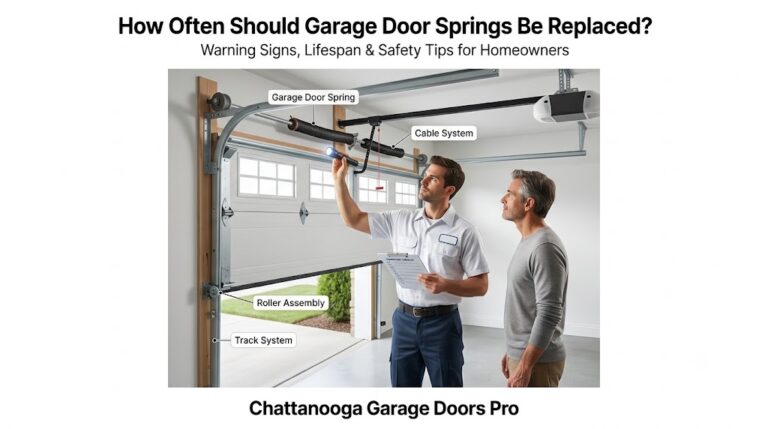
The torsion spring above the door is what actually lifts the weight — the opener motor is far too weak to lift a 300-pound door on its own. As springs age, they lose lifting force. A spring with roughly 20% of its life left may still open the door slowly but stop partway because the opener has to do more work than it’s designed for. When a torsion spring breaks, the door loses the counterbalance force needed to fully open. It’s very common for old, worn torsion springs to break and cause the door to stop a few feet up before stalling. A loud bang or snap from the garage is the telltale sign of a broken torsion spring. After the bang, the door typically does one of three things: it won’t move at all, it lifts a few inches before the opener stalls, or it goes up partway and drops back down. All three are consistent with a broken spring.
A broken torsion spring almost always shows a visible gap in the coil — the two halves will be clearly separated, as if someone unscrewed a section out of the middle. If you see this, do not attempt to operate the door. Torsion springs are under extreme tension, and a DIY replacement can cause serious injury. This is a job for a licensed technician. The garage door spring replacement cost is modest compared to the risk of a DIY attempt.
Cause 4: Incorrect Travel Limit Settings
The travel limits tell the opener the exact positions of the fully open and fully closed door. If the “up” limit is set too low, your door may stop early, thinking it’s fully open. The same goes for the “down” setting — if it’s off, your garage door might stop when closing, thinking it hit the ground too early. When the down limit is set slightly too high, the opener thinks the floor is higher than it really is. The door reaches that phantom floor, the motor stops, and because the door is not actually resting on anything, the opener may then read the leftover tension as an obstruction and reverse. When the down limit is set slightly too low, the opener keeps driving after the door has already hit concrete, the door bottom compresses, the motor senses the sudden resistance, and again the door reverses. Either way, a down limit that is off by even half an inch is enough to produce the classic close-then-reopen or stop-halfway behaviour.
How to fix: On older chain and screw-drive units, limit switches are adjusted with physical screws on the motor head. One full turn typically equals about 2 inches of door travel. On newer smart openers, limit programming is done electronically through the wall control or a panel on the opener. The adjustment process varies by brand, so consult your owner’s manual. After every adjustment, run a full open-close cycle to verify the door travels smoothly and stops in the correct position. If the door still stops halfway after multiple adjustments, the travel module may be failing and need replacement. This is one of the most common issues our technicians resolve during a service call.
Cause 5: Worn or Damaged Rollers
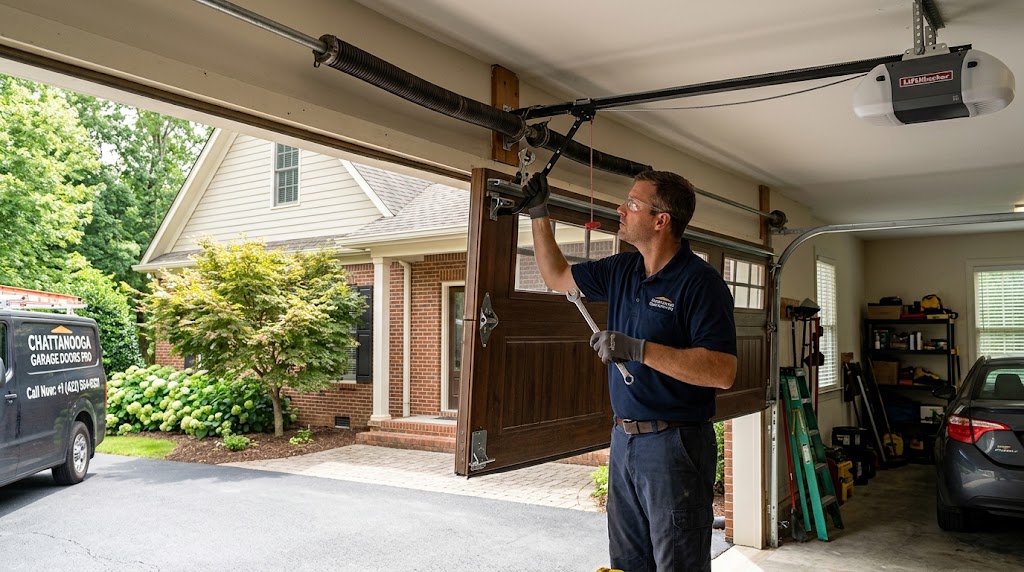
The door rides on rollers that travel inside the metal tracks. Over time, these rollers can wear out, crack, or lose their bearings. When a roller fails, the door binds in the track, creating resistance that the opener interprets as an obstruction. The result is a door that stops halfway up. Worn rollers often make grinding or squealing noises during travel, and the door may shake or wobble as it moves. Lubricating the rollers and hinges with a garage-door-specific lubricant can solve minor stiffness. However, if the rollers are cracked, flat-spotted, or missing, they need to be replaced. A professional can replace the full set of rollers during a routine service call.
Cause 6: Logic Board or Travel Module Failure
If you’ve ruled out sensors, obstructions, springs, and limit settings, the problem may be in the opener’s brain. The logic board controls all opener functions — receiving signals from the sensors, commanding the motor, and monitoring travel. The travel module communicates the position of the door to the logic board. Both of these parts wear out over time and will need replacement. If your garage door is struggling to find its correct position and is stopping intermittently, that can mean poor communication from the travel module. A failing logic board can cause the door to behave erratically: stopping mid-cycle, reversing for no apparent reason, or refusing to respond to commands.
Diagnosing a logic board or travel module issue requires a multimeter and a working knowledge of low-voltage electronics. If you’re not comfortable working with electrical components, this is a job for a technician. The good news is that opener repairs are often less expensive than full replacement. If your opener is more than 10–12 years old and you’re experiencing multiple electronic issues, upgrading to a modern smart garage door opener may be the more economical choice. Modern smart openers offer real-time door status alerts, remote access through mobile apps, and rolling code technology that improves security and reduces emergency calls. If connectivity is part of the problem, our guide to WiFi garage door opener not connecting can help.
Quick Diagnosis: What to Check First
Follow these steps in order to narrow down the cause:
- Disconnect the opener. Pull the emergency release cord to disengage the door from the opener. Try to lift the door manually. If it still stops at the same height, the problem is mechanical — likely a spring, roller, or track issue. If it moves freely, the problem is in the opener — likely a force or limit setting.
- Test the door’s balance. With the opener disconnected, lift the door halfway and let go. A properly balanced door will stay in place. If it slides down, the springs are weak or broken. If it shoots upward, the springs are too strong.
- Inspect the tracks and rollers. With the door closed, look along both tracks for bends, dents, or debris. Check that all rollers are seated inside the tracks and that none are cracked or missing.
- Check the opener’s force and limit settings. If the door moves freely manually but stops when using the opener, the issue is likely in the opener’s settings. Adjust the up-force in small increments and test.
- Look for a broken spring. With the door closed, look at the torsion spring above the door. A broken spring almost always shows a visible gap in the coil. If you see this, stop and call a professional.
These checks will give you a clear picture of whether you’re dealing with a simple adjustment issue or a more serious mechanical failure. If you’re unsure at any point, stop and call a professional.
When to Call a Professional
Some fixes — clearing track obstructions, adjusting limit settings, lubricating rollers — are safe for a confident DIYer. But the moment the problem involves springs, cables, or the internal electronics of the opener, it’s time to step back. Torsion springs are under extreme tension, and a snapped cable can whip free with enough force to cause serious injury. If the door feels heavy, if you heard a loud bang, or if the door is visibly off its tracks, do not attempt a DIY repair. These are clear emergency garage door repair situations.
A licensed technician will do more than just fix the immediate symptom. They’ll check the door’s balance, inspect the bearings, test the opener’s force settings, and lubricate all moving parts. This comprehensive approach ensures the repair addresses the root cause, not just the stop. If you’re wondering how to find a reliable pro, our guide on how to choose the best garage door company in Chattanooga walks you through the questions to ask and the red flags to avoid.
Prevention: Keep Your Door Moving Smoothly
Most garage door problems develop gradually. A little preventive maintenance goes a long way toward keeping your door operating reliably:
- Lubricate moving parts twice a year. Use a silicone-based or white lithium grease on rollers, hinges, and the torsion shaft. Avoid WD-40 as a long-term lubricant — it attracts dust.
- Test the door’s balance annually. Disconnect the opener and lift the door halfway. If it doesn’t stay in place, call a technician to adjust the springs.
- Keep the tracks clean. Wipe down the tracks with a damp cloth and check for loose bolts or brackets.
- Schedule a professional tune-up every 12–18 months. A technician can catch worn springs, misaligned tracks, and failing sensors before they cause a stop. Our seasonal garage door maintenance guide for Chattanooga homes explains what to check each season.
For more troubleshooting tips and maintenance advice, browse our blog.
Frequently Asked Questions
1. Why does my garage door stop halfway up?
The most common causes are an opener force setting that’s too low, an obstruction in the track, worn rollers, a failing torsion spring, or incorrect travel limit settings. Start by disconnecting the opener and testing the door manually to narrow it down.
2. Can I fix this myself?
Clearing track obstructions, lubricating rollers, and adjusting force or limit settings are safe DIY tasks. However, if the door feels heavy, you heard a loud bang, or the springs look damaged, do not attempt a repair. Call a professional immediately.
3. How do I know if the problem is the springs or the opener?
Disconnect the opener using the emergency release cord and try to lift the door manually. If it’s extremely heavy or won’t stay up, the springs are the problem. If it moves freely by hand but stops when using the opener, the issue is in the opener’s settings or electronics.
4. Is a garage door that stops halfway an emergency?
If the door is stuck open, it’s a security risk. If you suspect a broken spring or a snapped cable, it’s an emergency — the door can fall without warning. Do not use the door and call a technician right away. Our guide to emergency garage door repair signs explains which symptoms require immediate action.
5. How much does it cost to fix a garage door that stops halfway?
The cost depends entirely on the cause. A force or limit adjustment is often part of a routine service call. A spring replacement typically ranges from $200 to $700. See our full breakdown of garage door spring replacement cost for details. If your opener is old and failing, our guide to garage door installation cost in Chattanooga TN can help you budget for a replacement.
Don’t Let a Halfway Door Leave You Stranded
A garage door that stops halfway is more than an inconvenience — it’s a system warning. Whether it’s a misaligned force setting, a worn spring, or a failing opener, the underlying cause will only get worse with time. In Chattanooga, Hixson, East Ridge, and Ooltewah, our licensed technicians can diagnose the problem and restore your door’s reliable operation — often in a single visit. We test the full system, replace worn parts with factory-spec components, and never leave a job until the door operates the way it should. Call now to schedule your repair.
Call (423) 564-8231